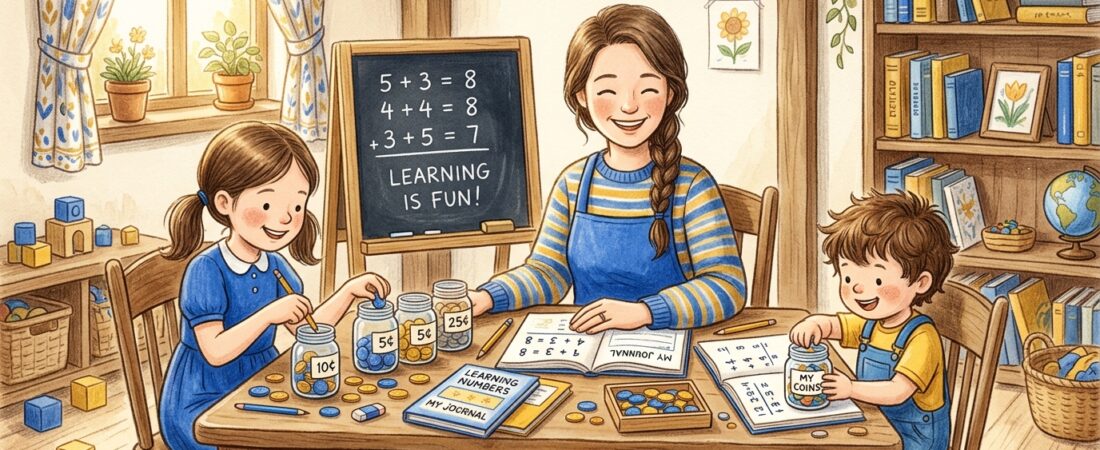
Why Teaching Money Math to Kids at Home Is One of the Best Gifts You Can Give
When it comes to teaching money math to kids at home, Christian homeschool moms have a unique and powerful advantage: you can weave biblical stewardship right into every lesson. From counting pennies at age two to calculating percentages for a tithe at age twelve, financial literacy is a life skill that starts earlier than most parents realize. The good news is that you do not need a fancy curriculum or a background in finance to make it happen. With a few intentional habits, some hands-on tools, and a heart anchored in Scripture, you can raise kids who understand the value of money — and Who it ultimately belongs to.
Faith Filled Learning is reader-supported. When you buy through links on our site, we may earn an affiliate commission at no extra cost to you.
Start with Coins and Counting: Money Math for Ages 2–5
Even toddlers can begin learning about money in simple, tactile ways. At this age, the goal is not abstract math — it is sensory exploration and vocabulary building. Pull out a handful of coins and let your little one touch, sort, and name each one. Say “penny,” “nickel,” “dime,” and “quarter” clearly and consistently, and soon your two-year-old will be identifying them on sight.
A great tool for this stage is a Learning Resources Money Bags Coin Value Game, which makes sorting and matching coins feel like play rather than school. You can also set up a simple pretend store in your living room using toy food, price tags made from index cards, and real coins. Let your preschooler “pay” you for bananas and apples — it builds number sense and social skills at the same time.
Pair these activities with a short Bible truth: “The earth is the Lord’s, and everything in it” (Psalm 24:1). Even young children can begin to understand that money is a tool, not a treasure, and that God is the ultimate owner of all things.
For more ideas on building early learning foundations, check out this guide on how to teach the alphabet to toddlers — many of the same hands-on strategies apply beautifully to early math concepts too.
Building Real Math Skills: Money Lessons for Ages 6–9
Once your child can count reliably and understands basic addition and subtraction, money math can become much richer. In 2026, there are more resources than ever to help homeschool families make this stage engaging and meaningful.
Start by introducing the concept of making change. Give your child a small “store budget” — say, one dollar — and let them shop from a table of items you have priced with handwritten tags. This single exercise practices addition, subtraction, comparison, and decision-making all at once. You can also introduce a simple three-jar system for allowance: one jar for giving (tithe and offerings), one for saving, and one for spending. This gives money a moral framework that aligns with Proverbs 3:9: “Honor the Lord with your wealth.”
For structured practice, a workbook like Math in Focus Money Workbook can provide the repetition kids need to master coin values and dollar amounts without turning practice into a chore. Pair workbook time with real-life grocery shopping trips where your child holds the list, compares prices, and helps calculate the total.
If you are looking for a solid math foundation to build from, our review of Christian homeschool math curriculum options can help you find a program that fits your family’s style and budget.
Leveling Up: Money Math Concepts for Ages 10–12
By the time your child reaches the upper elementary years, money math can expand into genuinely exciting territory: percentages, budgeting, simple interest, and even basic investing concepts. These are skills that will serve them for the rest of their lives — and this is where biblical stewardship really comes into focus.
Walk your child through creating a simple monthly budget. Give them a pretend monthly income — say, $100 — and a list of pretend expenses like rent, food, transportation, and fun money. Have them allocate their income, calculate what percentage goes to each category, and figure out how much is left to save. This exercise alone covers multiplication, division, fractions, and percentages in a meaningful context.
Introduce the concept of tithing as a math problem: if you earn $50 mowing lawns, 10% goes to God’s work — how much is that? From there, explore questions like: what if you saved 20% every month for a year? This naturally leads into discussions about compound interest and long-term thinking. Khan Academy offers free video lessons on percentages and basic personal finance that work wonderfully as supplements to your homeschool day.
You might also encourage your older child to keep a spending journal for one month, tracking every penny in and out. This habit builds self-awareness and financial discipline that no worksheet can fully replicate.
Making It Faith-Centered: Stewardship as a Way of Life
One of the greatest gifts of homeschooling is the ability to integrate your faith into every subject — and money math is no exception. Rather than treating financial literacy as a purely practical skill, frame it within a biblical worldview from the very beginning.
Discuss Bible stories that involve money and stewardship: the Parable of the Talents (Matthew 25:14–30), the widow’s mite (Mark 12:41–44), and Zacchaeus the tax collector (Luke 19:1–10). These stories are not just Sunday school material — they are living illustrations of concepts like investment, generosity, and integrity that deepen every money lesson you teach.
Encourage your kids to brainstorm ways to earn money and then give some away intentionally. Let them choose a missionary, a local food bank, or a church building fund to support. When a child cheerfully gives from their own savings, the lesson of generosity moves from the head to the heart. Focus on the Family offers wonderful family-centered resources on raising generous, financially wise children at focusonthefamily.com.
Also consider weaving money conversations into your morning basket or family devotion time. A short discussion about a financial decision a Bible character made can spark more curiosity than a whole page of worksheets. For inspiration, explore our collection of family devotions for homeschool that you can adapt to include stewardship themes.
Hands-On Tools and Games That Make Money Math Stick
Children learn best by doing, and when it comes to money, the more real it feels, the better the learning sticks. Here are some tried-and-true approaches that homeschool moms love in 2026.
Play store regularly. Rotate the products and increase the complexity as your child grows. A five-year-old pays with exact coins; a ten-year-old calculates tax and makes change from a twenty-dollar bill.
Use real money when possible. Plastic coins are great for toddlers, but transitioning to real coins and bills as soon as it is safe adds authenticity that children respond to. Real money feels important because it is.
Try board games. Classic games that involve buying, selling, and managing money build financial intuition in a no-stakes environment. Look for editions that match your child’s level and interests.
Set a savings goal together. Help your child identify something they want to save for — a book, a craft kit, a special outing — and create a simple chart to track their progress. Watching a goal become reality is one of the most motivating financial lessons a child can experience.
Read aloud books about money. There are wonderful children’s books that explore earning, saving, giving, and wise spending in age-appropriate ways. Weaving these into your read-aloud time normalizes financial conversations in your home.
Frequently Asked Questions
At what age should I start teaching money math to my kids?
You can introduce simple coin recognition and sorting as early as age two or three. By age four or five, children can begin matching coins to their values and playing pretend store. Formal math skills like addition and subtraction with money work well starting around ages six or seven, depending on your child’s readiness.
Do I need a separate money curriculum, or can I use what we already have?
You do not need a separate curriculum. Most solid math programs include money units, and you can supplement those with real-life practice, games, and conversations. That said, if your child is struggling with money concepts specifically, a targeted workbook or unit study can help fill the gaps quickly.
How do I tie biblical stewardship into everyday money lessons without it feeling forced?
The key is consistency over intensity. Keep a few key Scripture verses about money visible in your homeschool space, revisit them naturally when financial topics come up, and model generous giving in your own life. When children see stewardship lived out rather than just taught, the lessons take root deeply and naturally.
What if my child is resistant to money lessons or finds them boring?
Make it real and make it theirs. Children tune out abstract worksheets but light up when they have their own money to manage — even a small allowance or earnings from simple chores. Give them agency to make real (low-stakes) decisions with their money, and their interest will follow quickly.
Conclusion: Raise Faithful Stewards One Lesson at a Time
Teaching money math to kids at home is not just about preparing them for the world — it is about preparing them to honor God with everything they have. As a Christian homeschool mom, you are perfectly positioned to blend the practical with the purposeful, turning every coin-counting session and grocery store trip into a small discipleship moment.
Start where your child is, use tools that fit your family, and lean into the conversations that money naturally invites. Whether your little one is sorting pennies on the kitchen table or your preteen is drafting their first real budget, every step forward is planting seeds of wisdom that will bear fruit for a lifetime.
Ready to keep building a well-rounded homeschool experience? Explore more of our favorite resources at Faith Filled Learning — from math to reading to devotions — and find the tools that help your family thrive.
Printables & faith-filled tees from our shop
Bible coloring and activity books, alphabet printables and homeschool planners — instant download, print at home. Plus Comfort Colors tees for homeschool moms who get it.
Every purchase supports this blog and keeps our free resources free.