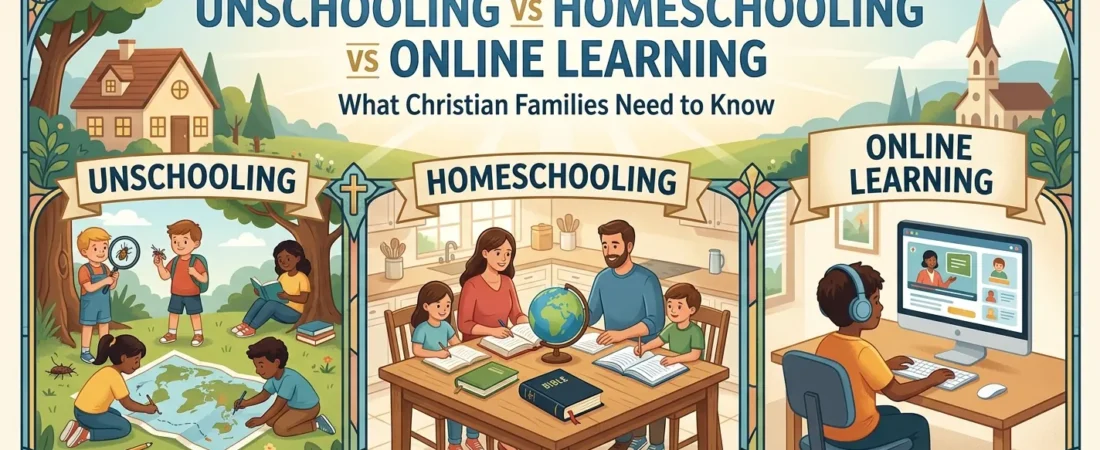
If you’ve found yourself Googling “unschooling vs homeschooling” at 10pm, you’re probably not just curious — something pushed you here. Maybe your child is struggling in a system that doesn’t share your values. Maybe you’re already homeschooling and wondering if you’re doing it “right.” Or maybe you stumbled across the word unschooling and thought — wait, is that actually what we’ve been doing?
Faith Filled Learning is reader-supported. When you buy through links on our site, we may earn an affiliate commission at no extra cost to you.
You’re not alone. More Christian families than ever are pulling their kids out of traditional school, and the options can feel overwhelming. This guide breaks down all three approaches so you can make a confident, faith-informed decision for your family.
What Is Traditional Homeschooling?
Homeschooling is parent-directed education at home, usually following a structured curriculum. You choose the materials, you set the schedule, and you are the teacher.
For Christian families, this often means selecting faith-based curriculum — programs like Masterbooks, Notgrass History, or Heart of Dakota — that integrate a biblical worldview into every subject. Math isn’t just math. History isn’t taught from a secular lens. Science doesn’t contradict your faith.
This is the most common choice for families leaving the traditional school system, and for good reason. It gives you full control over what your children are learning and who is shaping their worldview.
What it looks like in practice:
- A set daily or weekly schedule
- Structured lesson plans across core subjects
- Parent-selected curriculum aligned with family values
- Regular assessment to track progress
Best for: Families who want structure, consistency, and full control over curriculum and worldview. If you’re just getting started, read our full guide to the best Christian homeschool curriculum for elementary kids.
What Is Unschooling?
Unschooling is child-led learning. There is no set curriculum, no formal lessons, and no scheduled school day. Children learn by following their natural curiosity — through real life, play, conversation, and exploration.
Parents act as facilitators, not teachers. They provide resources, answer questions, and create an environment rich with opportunity. But the child decides what to learn and when.
Here’s what most people miss: if you’ve ever let your son spend three hours building with Legos while you talked through the engineering principles, or let your daughter deep-dive into horses for a month because she was obsessed — you’ve done unschooling. You just didn’t call it that.
Unschooling isn’t the absence of learning. It’s the absence of artificial structure around learning.
What it looks like in practice:
- No set schedule or formal lessons
- Learning follows the child’s interests and questions
- Real-world experiences replace textbook instruction
- Parents stay engaged but don’t direct
The honest concern for Christian families: does child-led learning conflict with intentional, faith-filled parenting? Proverbs 22:6 tells us to train up a child in the way he should go. That implies intention and direction — not passivity. Most Christian families who incorporate unschooling principles do it selectively, maintaining structure for core subjects while allowing self-directed exploration where their child shows strong interest.
Best for: Families who want to deschool after a bad school experience, or who want to supplement structured homeschooling with child-led exploration.
What Is Online Learning?
Online learning means your child completes their education through a digital platform — video lessons, interactive quizzes, live virtual classes, and online assignments.
For many Christian homeschool families, online learning is the option they quietly ruled out — not because it doesn’t work, but because it trades one screen for another. If you pulled your child from school partly to reduce passive screen exposure and reclaim real-world, relational learning, sitting them in front of a computer for six hours a day doesn’t solve the problem.
Online learning can be a useful supplement — a math program here, a writing course there — but for families prioritizing presence, connection, and a biblical learning environment, it rarely fits as the primary approach.
Best for: Families who need flexibility due to work schedules, or who want to supplement homeschooling with specific online courses.
Unschooling vs Homeschooling: What the Research and Real Families Show
According to the National Center for Education Statistics, the number of homeschooled students in the US has grown steadily over the past decade. The top reasons families choose home education consistently include concern over school environment, desire to provide religious instruction, and dissatisfaction with academic instruction.
Most parents don’t arrive at this decision from a place of calm curiosity. They arrive frustrated. Their child is struggling in a system that doesn’t see them. The school is teaching values that directly contradict their faith. Their kid comes home anxious, disengaged, or quietly absorbing a worldview the family never agreed to.
Unschooling often appeals in that moment because it sounds like the antidote — total freedom, no system, no pressure. And there’s something right about that instinct. When you discover that there are families raising capable, curious, thriving kids with no formal lesson plans — just life, exploration, and intentional presence — it quietly answers a fear you’ve been carrying. The fear that you’re falling behind. That you’re not doing enough. That a “real” teacher would do this better.
Unschooling, in that sense, is reassuring proof that children are remarkably good at learning when they are loved, engaged, and given space. It doesn’t mean you should abandon your curriculum. It means you can stop white-knuckling every school day and trust that the life you’re building together is teaching more than you realize.
The field trip that ran long. The afternoon your son couldn’t stop asking questions about volcanoes. The week your daughter learned more about fractions from baking than from any worksheet. That was unschooling. It was also good homeschooling. The line between unschooling vs homeschooling is thinner than the labels suggest.
One Thing Both Approaches Require
Homeschooling and unschooling both demand the same thing: your presence.
Neither works for a family where the primary parent is away from the child most of the day. Unschooling isn’t benign neglect — it’s actually highly involved parenting, just without a lesson plan. And homeschooling without a present, engaged parent quickly becomes a child sitting alone with a workbook.
If your family situation requires both parents to work full-time, online learning may be the more realistic starting point — not because it’s better, but because it matches your actual life. There is no shame in that. The goal is an education that works, not one that looks right on paper.
What Most Christian Homeschool Families Actually Do
They blend. They start with a structured curriculum as the backbone, then let natural learning happen around it. Bible is taught intentionally. Math follows a sequence. But when a child becomes passionate about animals, or building, or cooking, or history — they follow it. They call it homeschooling. Some might call parts of it unschooling. The label matters less than the outcome.
To understand the full range of approaches available, read our breakdown of the different types of homeschooling methods — it covers everything from classical to Charlotte Mason to eclectic.
What matters is that you are the one shaping your child’s education, guarding their heart, and pointing them toward truth.
The Bottom Line
Choose homeschooling if you want structure, curriculum control, and full faith integration across every subject.
Add unschooling elements if your child needs to decompress, or if a subject lights them up and deserves open-ended exploration.
Use online learning selectively as a supplement — especially if screen time reduction is part of why you left traditional school.
Whatever you choose, you are already doing something countercultural and courageous. You decided that your child’s education is too important to outsource entirely. That is the foundation everything else is built on.
Printables & faith-filled tees from our shop
Bible coloring and activity books, alphabet printables and homeschool planners — instant download, print at home. Plus Comfort Colors tees for homeschool moms who get it.
Every purchase supports this blog and keeps our free resources free.