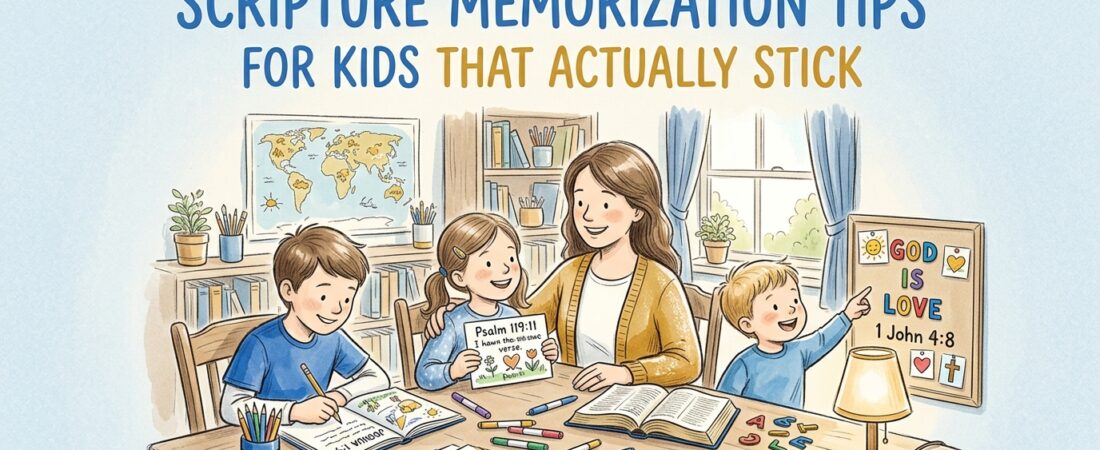
Why Scripture Memorization Belongs in Your Homeschool
If you are looking for scripture memorization tips for kids that work in a real house with real children, you are in the right place. We are not talking about flashcard drills that feel like a chore. We are talking about hiding God’s Word in little hearts in ways that feel as natural as singing in the car or saying grace before dinner. Psalm 119:11 says, “I have hidden your word in my heart that I might not sin against you.” That verse is the whole reason we do this. Not to check a box. Not to impress anyone at church. But because we want our children to carry truth with them when we are not in the room.
Faith Filled Learning is reader-supported. When you buy through links on our site, we may earn an affiliate commission at no extra cost to you.
The good news is that children are wired for this. Their brains absorb language, rhythm, and repetition at a rate we will never see again in their lifetime. The toddler who memorized the words to three cartoon theme songs this week can absolutely memorize Philippians 4:13. She just needs us to make it part of the air she breathes at home.
Scripture Memorization Tips for Kids by Age Group
What works for a ten-year-old is not what works for a three-year-old, and that is okay. Here is how we approach it across the ages in our homeschool.
Ages 2 to 4: At this age it is all about sound and repetition. We pick one short verse and we say it every single morning at breakfast. Not as a lesson. Just as something we say. “God is love. First John 4:8.” That is it. We say it together. We clap the syllables. We whisper it. We say it loud. By the end of two weeks she knows it. She does not know what First John means yet and that is fine. The Word is in her. Understanding comes over time.
Ages 5 to 7: At this age kids can handle a little more structure. We write the verse on a small whiteboard and erase one word at a time across the week until they are reciting it from memory. We also tie verses to what we are already studying in Bible. If we are reading about David, we learn a psalm. Context makes it land. You can find great starting points for this age in our collection of Bible stories for kids ages 2 to 6 that pair naturally with memory work.
Ages 8 to 12: Older kids can memorize longer passages and understand them more deeply. We start asking why this verse matters, not just what it says. We might memorize the Beatitudes over a month, one line per week, and talk about what each one means for how we treat our siblings, our neighbors, our friends. Writing the verse in a journal and drawing something that represents it helps this age group connect meaning to memory.
Simple Daily Habits That Make Verses Stick
The secret to scripture memorization is not a special program. It is repetition woven into ordinary moments. Here is what actually works in our home.
Morning anchor: We start every school morning with our current memory verse. Just saying it together before we open any books sets the tone. The whole day feels a little more grounded.
Mealtime review: Before dinner we ask whoever wants to try to say the verse for the week. No pressure, no grade. Just a small celebration when someone gets it right. Even the littles try.
Car time: If your kids spend any time in the car, that is gold. We put on a scripture song version of whatever verse we are working on and just let it play. Songs carry words into memory better than almost anything else. Classical Conversations uses this method extensively, and it works beautifully. You can read more about how that program structures memory work in our Classical Conversations review.
Write and post: We write the verse on an index card and tape it somewhere we all pass during the day. The bathroom mirror. The fridge. Above the kitchen sink. Passive exposure adds up faster than you expect.
Reward the effort, not the perfection: When a child tries and stumbles, we celebrate the trying. When she nails it, we make a small moment of it. A sticker on a chart. A special dessert pick. Nothing elaborate. Just enough to say this matters and you did something worth noticing.
How to Choose Which Verses to Memorize
This question comes up a lot. There is no single right answer, but here is how we think about it in our homeschool.
Start with verses your children will actually need. Verses about fear for the child who struggles with anxiety. Verses about kindness for the season when sibling conflict is high. Verses about identity for the tween who is starting to wonder who she is. Scripture is not abstract. It is practical and personal and the more your child feels that, the more she will want to carry it with her.
Many families follow a structured program and that is a wonderful option too. Programs like those offered through Classical Conversations build scripture memorization into a broader classical framework that spans years. If you prefer something less structured, simply work through the Psalms, the Sermon on the Mount, or a book like Proverbs one verse at a time. There is no wrong entry point. Just start somewhere.
You might also consider aligning memory work with your Bible curriculum. If you do not have one yet or are looking to strengthen that part of your homeschool, we have a full breakdown of options in our guide to the best Bible curriculum for homeschoolers.
When It Feels Like It Is Not Working
We have all had those mornings. You say the verse. Your seven-year-old stares at you like you are speaking another language. Your four-year-old runs away. Your ten-year-old sighs. And you wonder why you bother.
You bother because the Word does not return void. Isaiah 55:11 tells us that. We do not always see the moment the seed takes root. But we trust the One who planted it. Our job is faithful, consistent exposure. His job is the transformation.
Some kids memorize easily. Some need a hundred repetitions. Some will surprise you by reciting a verse two years after you thought they forgot it. Do not measure success by how quickly they can perform it on demand. Measure it by whether you kept showing up and making space for it. That is the whole job.
Keep it low pressure. Keep it joyful when you can. And on the hard days, even just saying the verse yourself while you make breakfast counts. They are listening even when they look like they are not.
Building a Home Where God’s Word Lives
Scripture memorization is not a standalone subject. It is part of a bigger picture of a home where faith is woven into the ordinary. The verse on the fridge, the prayer before the test, the conversation in the car when something hard happens — all of it together is what shapes a child’s understanding of who God is and who she is because of Him.
We have the privilege of being with our children all day. That is not always easy, but it is an extraordinary gift. Use those ordinary moments. Say the verse at breakfast. Sing it in the car. Write it on a card. Say it again tomorrow. That is the whole method. Faithful repetition in a loving home. It works because God designed it to work, and He designed you to do this.
Printables & faith-filled tees from our shop
Bible coloring and activity books, alphabet printables and homeschool planners — instant download, print at home. Plus Comfort Colors tees for homeschool moms who get it.
Every purchase supports this blog and keeps our free resources free.