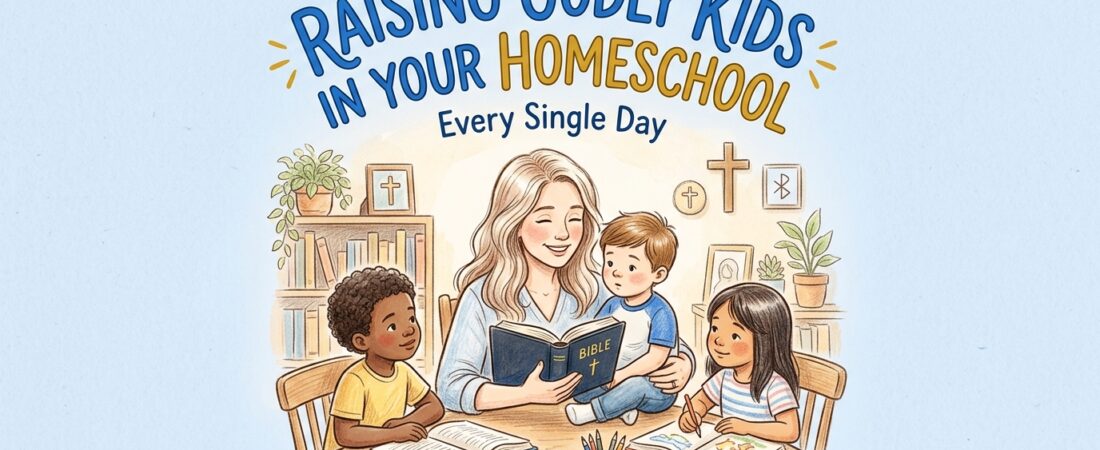
Raising godly kids is not something that happens because you picked the right curriculum or said the right prayer at the start of the school day. It happens in a thousand small moments — the way you respond when you are frustrated, the way you stop the math lesson to talk about what honesty actually costs, the way you keep showing up even when you are tired. If you are homeschooling in 2026 and wondering whether you are doing enough to shape the hearts of your children, this is for you. You are already doing more than you know.
Faith Filled Learning is reader-supported. When you buy through links on our site, we may earn an affiliate commission at no extra cost to you.
Raising Godly Kids Starts Before the Books Come Out
Our school day does not begin when we open a textbook. It begins the moment our kids wake up and start watching how we live. Are we patient when breakfast goes sideways? Do we say we are sorry when we snap? Do we pray out loud when something hard happens, or do we just quietly worry? Kids learn character by watching character. That is not a guilt trip — it is actually good news. It means the most powerful tool we have is not a workbook. It is our life lived in front of them.
In our homeschool, we make it a point to name what we are doing. If I choose to forgive someone who was unkind to me, I say that out loud. I say, I am choosing to forgive because that is what God asks me to do and it is not easy today. My kids need to see that godliness is not automatic. It is a daily decision, and it is hard sometimes, and it is worth it every time.
If you want support building Bible time into your actual school day — not as a bonus but as a foundation — family devotions for homeschool is a great place to start. We have found that even ten focused minutes in the morning sets the whole tone differently than when we skip it.
Character Is Caught in the In-Between Moments
Nobody learns patience during a calm afternoon. They learn it when a sibling takes their book, when a project falls apart, when lunch is not what they wanted. Those are not interruptions to our homeschool. Those are the homeschool. The curriculum handles math and reading and writing. The rest — how to treat your brother, how to lose gracefully, how to tell the truth when it costs you something — that is what the hours together are for.
We practice this by not rushing past hard moments. When two kids are in a conflict, we stop. We sit down. We talk through it like it matters, because it does. I am not always calm when I do this. Some days I have to take a breath and remind myself that this is the real work. Raising godly kids means treating character formation as seriously as we treat a spelling test.
Some practical things that have made a difference in our home: keeping a short memory verse on the whiteboard each week, reading aloud books where characters face real moral choices, and asking at dinner what was hard today and what they chose to do about it. These are not complicated. They are just consistent.
For families wanting to tie Scripture into these daily conversations more intentionally, scripture memorization tips for kids has some really simple approaches that work across different ages and attention spans.
What a Christian Homeschool Actually Looks Like Day to Day
I want to be honest with you about what our days look like, because I think we can build up a false picture in our heads of what a godly homeschool is supposed to feel like. Some mornings we start with prayer and it is sweet and focused. Some mornings someone is crying before we even get to the table. Both kinds of mornings are our real life, and God is in both of them.
In 2026, there are more curriculum options than ever for families who want their faith woven into every subject. History, science, literature — you can find materials that do not treat Christianity as a footnote. That matters. When your kids are reading about creation from a biblical worldview or learning history through the lens of God’s sovereignty, it reinforces what you are teaching them about who He is. Resources like those reviewed at Master Books are built specifically for families who want that integration to be real, not just a sticker on the cover.
But even the most faith-saturated curriculum cannot replace a mom who stops a lesson to pray with her child over something they are afraid of. The books support what you are building. They do not build it for you.
Raising Godly Kids When You Are Running on Empty
This section is for the days when you have nothing left. When you have been patient for six hours straight and someone has just pushed that last button. When you wonder if any of this is actually making a difference. I have been there more times than I can count. You probably have too.
Here is what I keep coming back to: God did not call us to raise perfect kids. He called us to be faithful. Faithful means you show up again tomorrow. It means you say sorry when you got it wrong today. It means you do not quit just because today was hard. That faithfulness is not invisible to your children. They are watching you come back. They are learning from you that love does not leave when things get difficult.
On the hard days, I try to get back to something small and grounding. A short devotional. A five-minute walk outside. A moment where I just sit with my kids without any agenda. These are not fixes. They are ways of staying connected when disconnection feels easier.
If the weight of homeschooling ever starts to feel like too much, Focus on the Family has solid encouragement and practical support for Christian parents navigating these exact pressures. You do not have to carry it all alone.
The Long View of a Godly Home
We are not going to see most of what we are planting right now. Some of it will show up in five years. Some of it in twenty. We are teaching our two-year-old to share and our twelve-year-old to serve and our eight-year-old to be honest when no one is watching, and we are trusting that God is going to do something with all of that. That is an act of faith in itself.
Raising godly kids is not a program you complete. It is a direction you keep walking in together, as a family, with grace for the stumbles and gratitude for the good days. Your home is a discipleship environment. You do not need a degree for that. You need the same thing you have always had — a love for your kids and a dependence on God to make up the difference where you fall short.
That is enough. It really is.
If you are looking for more practical ways to build your faith foundation into your homeschool structure, explore the best Bible curriculum for homeschoolers to find tools that support what you are already building at home every day.
Printables & faith-filled tees from our shop
Bible coloring and activity books, alphabet printables and homeschool planners — instant download, print at home. Plus Comfort Colors tees for homeschool moms who get it.
Every purchase supports this blog and keeps our free resources free.