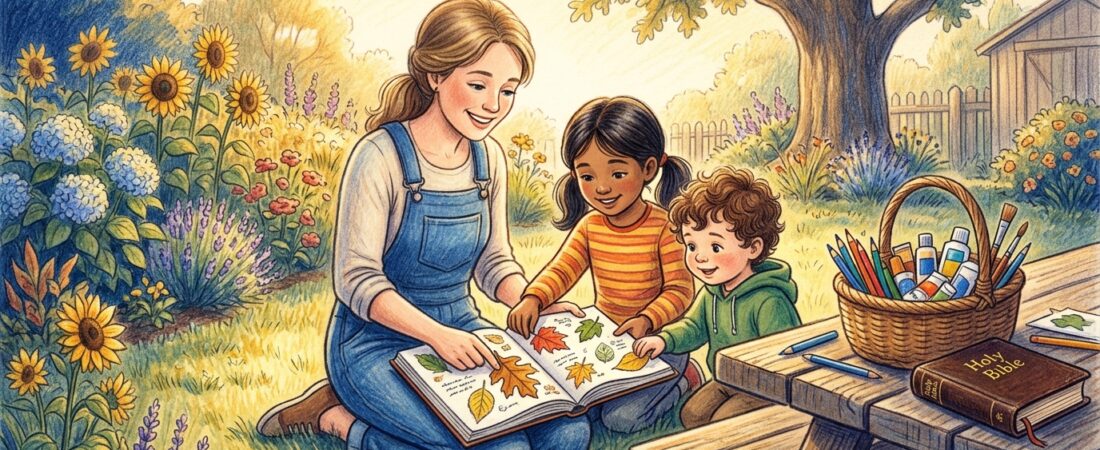
Why Outdoor Learning Activities for Homeschool Kids Are a Gift from God
If you are searching for meaningful outdoor learning activities for homeschool kids, you are in exactly the right place. Getting your children outside is one of the most powerful and joyful things you can do in your homeschool day. Whether your kids are toddlers just discovering worms in the soil or older children mapping constellations at dusk, the natural world God created is the ultimate classroom. Fresh air, natural textures, living creatures, and open skies all invite wonder — and wonder is the beginning of wisdom. In 2026, more Christian homeschool families than ever are embracing nature-based learning, and the ideas below will help you make it a regular, faith-filled part of your rhythm.
Faith Filled Learning is reader-supported. When you buy through links on our site, we may earn an affiliate commission at no extra cost to you.
Nature Journaling and Outdoor Observation for All Ages
One of the most timeless outdoor learning activities for homeschool kids is the nature journal. Inspired by Charlotte Mason’s philosophy of living education, nature journaling trains children to slow down, observe carefully, and record what they see with both words and drawings. For children ages 2-4, this can look as simple as picking up leaves and pressing them onto a page while you narrate what you see together. Older children can sketch insects, label plant parts, or write short scripture verses that connect to what they observe in creation.
A great resource to guide this practice is nature journaling for kids in the Christian homeschool, which walks you through exactly how to get started. You can also grab a quality nature journal for kids to make it feel special and official for your children. For deep inspiration on the Charlotte Mason approach that undergirds so much of outdoor learning, Simply Charlotte Mason offers a treasure trove of practical guidance.
Nature journaling builds observation skills, handwriting practice, vocabulary, and science knowledge all at once. It also nurtures gratitude as children begin to notice the intricate details of what God has made. Even a 20-minute session once or twice a week yields remarkable growth over a full school year.
Hands-On Science in Your Backyard or Local Park
Science does not have to happen at a table with a worksheet. In 2026, some of the most effective science instruction for homeschool kids ages 4-12 happens outside with simple tools and open-ended questions. Start by making a habit of turning over rocks to examine the ecosystem underneath. Talk about decomposers, soil health, and how God designed every creature with a purpose. Plant a small garden and let your kids chart the growth weekly. Study the water cycle by leaving a shallow dish outside and measuring evaporation each morning.
For structured outdoor science that aligns with a biblical worldview, Answers in Genesis provides outstanding free and purchasable materials that connect creation science to outdoor exploration. You can also check out the best Christian homeschool science curriculum options to find one that encourages hands-on outdoor activities alongside your textbook lessons.
For younger children, seasonal activities like collecting acorns in autumn, observing ice formation in winter, and watching butterflies emerge in spring make science feel magical and memorable. For kids ages 8-12, you can add structured experiments like testing soil pH, observing cloud formations with a weather log, or building simple bird feeders and recording which species visit throughout the week.
Outdoor Learning Activities for Homeschool Kids That Teach Faith and Character
The outdoors is one of the richest places to cultivate scripture memory, worship, and character formation. Take your morning Bible time outside when weather allows. Read a Psalm while sitting in the grass and let the imagery come alive — streams of water, mountains, birds of the air. Ask your children what they notice in creation that reflects the character of God. These conversations are short but they plant seeds that last a lifetime.
You can also weave in outdoor learning activities that build responsibility and stewardship. Assign each child a small plot or container garden to tend. Talk about what it means to be faithful with little things and connect it to the Parable of the Talents. For toddlers and preschoolers, simple tasks like watering plants or collecting sticks for a craft teach diligence without any pressure.
If you homeschool a toddler alongside older children, outdoor time often works as a natural equalizer where all ages can participate at their own level. The article on homeschooling a toddler and preschooler offers practical strategies for keeping little ones engaged while older siblings work on more complex outdoor projects.
For scripture memorization games that translate beautifully to outdoor settings, try writing verses on sidewalk chalk, hiding verse cards in the yard for a scripture scavenger hunt, or reciting memory work while jumping on a trampoline or swinging. Movement anchors memory, and the outdoors provides endless opportunities for both.
Seasonal Outdoor Unit Studies That Bring Every Subject Outside
Unit studies are a beloved approach in Christian homeschooling because they allow you to weave together multiple subjects around a central theme — and seasonal unit studies are perfectly designed to take learning outdoors. In 2026, you can plan a full week or month around topics like birds in spring migration, the water cycle in summer, harvest and thankfulness in autumn, or animal hibernation and God’s provision in winter.
For winter specifically, there are wonderful ideas in the winter nature study activities for kids guide that make cold-weather outdoor learning feel cozy and purposeful rather than daunting. A seasonal approach also fits naturally with the Charlotte Mason philosophy, which you can explore more deeply at Charlotte Mason nature study.
A practical tool to help you plan and organize these outdoor unit study weeks is a good homeschool planner. Keeping track of what your children observed, drew, wrote about, and discovered outdoors creates a beautiful record of their learning throughout the year. For ideas on keeping records that matter, visit homeschool record keeping to find a system that works for your family.
For read-alouds that pair perfectly with outdoor unit studies, consider the Handbook of Nature Study by Anna Comstock, a classic resource that Christian homeschool families have used for generations to guide outdoor observation across every season.
Frequently Asked Questions
How much time should we spend on outdoor learning each week?
Even 20 to 30 minutes outside three to four times a week makes a significant difference for young learners. You do not need long elaborate outdoor lessons. Consistency matters far more than duration, especially for children ages 2-6 whose attention spans are short but whose curiosity is enormous.
What if we live in a city without access to a lot of nature?
City homeschoolers can still enjoy rich outdoor learning. A sidewalk crack hosting a tiny ant colony, a potted herb garden on a balcony, a nearby park, or even a community garden plot are all excellent starting points. Nature observation is more about cultivating a habit of noticing than it is about having acres of forest at your disposal.
How do I incorporate outdoor learning if I have multiple children at very different ages?
Choose activities where each child can engage at their own level simultaneously. Nature walks, garden tending, weather journals, and free outdoor play all work beautifully across age ranges. Assign older children leadership roles like guiding a younger sibling’s observation or reading aloud from a nature guide, which reinforces their own learning while keeping everyone involved.
Do outdoor learning activities count toward our required homeschool hours?
In most states, yes — structured outdoor learning such as nature journaling, science observation, and garden-based math absolutely counts toward your homeschool hours. Requirements vary by state, so check your local regulations to be sure. You can find a helpful overview in the guide to the best states for homeschooling to understand what your state requires.
Take Your Homeschool Outside Starting Today
The good news is that you do not need a perfect plan, a big budget, or ideal weather to begin adding outdoor learning activities for homeschool kids to your days. You simply need a willingness to step outside, a sense of wonder, and a heart open to what God might teach both you and your children through the world He made. Start small — a five-minute walk where everyone finds one interesting thing, a cup of seeds pressed into a pot of soil, a single cloud sketched into a new journal. These small beginnings compound into something beautiful over time. Your children will remember the days they learned outside with you far longer than any worksheet. Go outside, breathe deeply, and let creation teach.
Printables & faith-filled tees from our shop
Bible coloring and activity books, alphabet printables and homeschool planners — instant download, print at home. Plus Comfort Colors tees for homeschool moms who get it.
Every purchase supports this blog and keeps our free resources free.