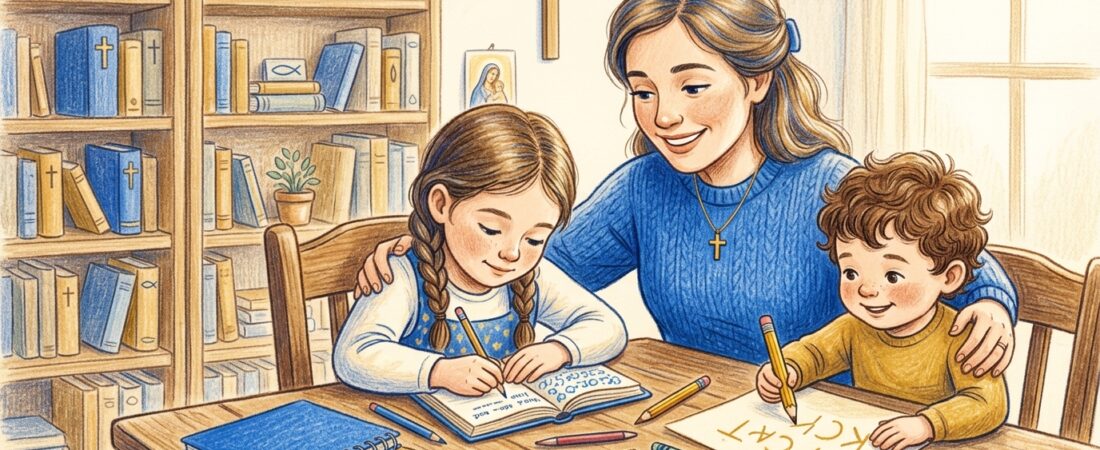
Why Choosing the Right Homeschool Writing Curriculum Matters
Finding the perfect homeschool writing curriculum can feel overwhelming, especially when you want something that aligns with your Christian faith and actually works for your kids. Whether you have a curious two-year-old just starting to grip a crayon or a motivated twelve-year-old drafting paragraphs, writing instruction is one of the most important investments you can make in your child’s education. A strong writing foundation builds communication skills, critical thinking, and confidence that will serve your children for life. As Christian homeschool moms, we also want curricula that reflect our values and give glory to God through the learning process.
Faith Filled Learning is reader-supported. When you buy through links on our site, we may earn an affiliate commission at no extra cost to you.
The good news is that in 2026, there are more faith-friendly writing programs than ever before, spanning every age group and learning style. This guide will help you sort through the options so you can find what truly fits your family.
What to Look for in a Homeschool Writing Curriculum for Young Children Ages 2 to 6
For the youngest learners, writing instruction begins long before pencil meets paper. At ages two through four, the focus should be on fine motor development, letter recognition, and pre-writing strokes. Look for programs that incorporate play, narration, and oral storytelling, because these are the building blocks of written expression. Christian programs in this age range often weave Bible verses and Scripture-based themes into early literacy activities, which helps reinforce faith while building skills.
Programs like those aligned with the Charlotte Mason philosophy encourage young children to narrate stories back to their parents, which is a powerful precursor to writing. If you are new to this approach, learning more about Charlotte Mason homeschooling can give you a solid framework for teaching writing naturally and joyfully in the early years.
For preschool-aged children, look for curricula that include copywork with short Bible verses, tracing pages, and illustrated journals. Programs that incorporate read-alouds and narration set a strong foundation. Resources from Read Aloud Revival can help you use books as springboards for early writing conversations and oral language development, which directly feeds into writing readiness.
Top Homeschool Writing Curriculum Options for Elementary Ages 6 to 12
Once children are reading and forming letters independently, you can introduce structured writing programs. Here are some of the most popular faith-friendly options Christian homeschool moms are using in 2026.
Institute for Excellence in Writing (IEW) is one of the most well-known homeschool writing curricula available. It uses a structured approach that teaches children to take notes, reorganize information, and write with style. IEW works well for kids who need clear steps and predictable structure. Many Christian families appreciate that the company is founded on Christian values, though the curriculum itself is not explicitly faith-based in all units.
Writing with Ease by Susan Wise Bauer fits beautifully within a classical homeschool framework and focuses on narration, copywork, and dictation in the early elementary years before transitioning to independent composition. It pairs well with history and literature-based curricula and is a strong choice for classical homeschoolers.
The Good and the Beautiful Language Arts is an extremely popular choice among Christian homeschool families. It integrates writing, grammar, spelling, and handwriting into one cohesive course, all with a wholesome, faith-friendly tone. The beautifully designed materials and affordable price point make it especially appealing. You can read a full review of The Good and the Beautiful to see if it is the right fit for your family.
Brave Writer is a creative writing curriculum that emphasizes a love of language and encourages children to write from their own hearts and experiences. It is especially popular among families who want a relaxed, literature-rich approach to writing. While not explicitly Christian, many Christian homeschool moms use it alongside faith-based literature selections.
Apologia’s Language Arts and writing supplements offer Christ-centered content woven into language arts instruction. Apologia is a trusted name in the Christian homeschool community, and their approach to writing ties directly to a biblical worldview.
How to Teach Writing Across Multiple Grade Levels at Once
One of the greatest challenges for homeschool moms teaching multiple children is finding a homeschool writing curriculum that can work across different ages without requiring an entirely separate lesson plan for each child. The good news is that many of the best programs are designed with this in mind.
Charlotte Mason-style copywork and narration can be adapted for almost any age. You might have your six-year-old copy a Bible verse while your ten-year-old writes a narration of the same passage in their own words. This kind of family-centered learning reduces your planning time and helps children at different levels feel like they are working together on something meaningful.
Unit studies are another excellent way to combine writing instruction across age groups. When the whole family studies a topic like creation, ancient history, or a missionary biography, children of every age can contribute written responses at their own level. Older children write paragraphs or essays while younger children draw and dictate their ideas. If you are interested in this approach, exploring homeschool unit studies can give you practical ideas for combining subjects and ages beautifully.
Consistency matters more than the curriculum itself. Children become confident writers when they write a little bit every single day. Even five to ten minutes of copywork or journaling builds tremendous skill over time.
Tips for Making Writing Enjoyable and Faith Centered in Your Homeschool
Many children resist writing because it feels hard or boring. As a Christian homeschool mom, you have a unique opportunity to reframe writing as an act of worship and a way to reflect on God’s goodness. Here are some practical strategies to make writing something your children actually look forward to.
Start with topics your children care about deeply. Let them write about their favorite Bible story, a prayer request, a family memory, or a creature they observed in nature. When children have something meaningful to say, the words come more naturally. You can also use Scripture memorization as a copywork resource, which builds both handwriting and a love of God’s Word at the same time.
Celebrate progress rather than perfection. Young writers especially need to hear that their efforts are valued. Display their writing on the refrigerator, read it aloud at dinner, or compile it into a simple family book at the end of the year. These small acts of celebration build enormous confidence.
Incorporate writing into your daily devotional time. Ask your children to write a sentence or two about what God is teaching them, what they are thankful for, or how a Bible passage applies to their lives. This practice develops both spiritual depth and writing fluency simultaneously.
For families navigating special learning needs such as dyslexia or motor difficulties, remember that oral narration is a valid and powerful form of writing instruction before pen-to-paper work becomes comfortable. Be patient, be consistent, and trust the process. Resources like those found at Master Books offer accessible, faith-based language arts programs that work well for a wide range of learners.
Choosing the Best Homeschool Writing Curriculum for Your Family in 2026
At the end of the day, the best homeschool writing curriculum is the one your family will actually use consistently. Consider your children’s ages, learning styles, and attention spans. Think about how much time you have to prepare lessons and how much you enjoy teaching writing yourself. Some moms thrive with a structured, scripted program that tells them exactly what to say each day. Others prefer a flexible, literature-driven approach that leaves room for creativity.
Pray over your decision and remember that God has called you specifically to educate your children. You know them better than any curriculum developer ever will. Trust your instincts, try one program at a time, and give yourself grace during the learning curve.
Whether you choose a classical program, a Charlotte Mason approach, or a structured writing curriculum like IEW or The Good and the Beautiful, you are doing something incredibly valuable by investing in your child’s ability to communicate clearly and beautifully. Writing is a gift, and you get to help your children unwrap it every single day.
Ready to take the next step? Browse through faith-filled reviews and resources to find the curriculum that will make 2026 your family’s best writing year yet. You are not alone on this journey, and there is a whole community of Christian homeschool moms cheering you on.
Printables & faith-filled tees from our shop
Bible coloring and activity books, alphabet printables and homeschool planners — instant download, print at home. Plus Comfort Colors tees for homeschool moms who get it.
Every purchase supports this blog and keeps our free resources free.