The Homeschool Socialization Question You Have Already Heard a Hundred Times
If you have been homeschooling for more than five minutes, someone has asked you about homeschool socialization. A relative at Thanksgiving. A neighbor at the mailbox. Maybe even a small voice in your own head at 10pm when you are second-guessing everything. The concern sounds reasonable on the surface: if your children are not in a classroom with thirty other kids, how will they learn to get along with people?
Faith Filled Learning is reader-supported. When you buy through links on our site, we may earn an affiliate commission at no extra cost to you.
Here is what I want to say to you before we go any further. You have been socializing your children since the day they came home from the hospital. You taught them to make eye contact and say please. You coached them through sharing a toy and apologizing after a meltdown. You modeled how to greet a stranger kindly and how to sit through something boring without complaining. That is socialization. Homeschooling did not end it. It gave it more room to breathe.
Still, the question deserves a real answer. Not a defensive one. Just an honest look at what homeschool socialization actually looks like when it is working, and how to build it with intention when it needs a little more structure.
What Homeschool Socialization Actually Looks Like in 2026
Our kids are not sitting in a room alone all day. Most homeschool families I know are busier than they planned to be. The challenge is not usually finding socialization opportunities. It is choosing which ones to say yes to without burning everyone out by Wednesday.
In 2026, homeschool families have more options than ever. Co-ops have exploded in size and variety. Ours meets twice a week and covers everything from science labs to speech and drama. The kids work in groups, navigate disagreements, wait their turn, and learn from adults who are not their parents. That is real social practice happening in a real context.
Beyond co-ops, there are church programs, sports teams, music lessons, art classes, 4-H groups, library reading programs, and neighborhood friendships. My oldest learned more about getting along with different personalities from one season of community soccer than from anything I could have engineered at home. None of that required a traditional school building.
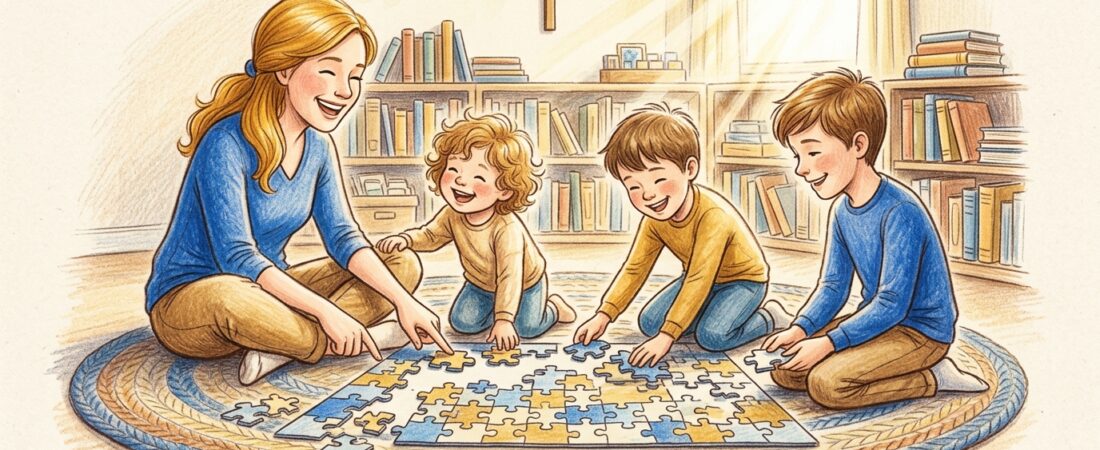
What homeschool socialization does look like differently from classroom socialization is this: our kids spend more time around mixed ages. A nine-year-old who reads to a five-year-old, helps a toddler with a puzzle, and then has a conversation with a grandparent at dinner has practiced three completely different social registers in one afternoon. That is not a deficit. That is a wider range of real-world experience than most adults get in a week.
If you are just getting started and wondering how to build community into your homeschool from the beginning, joining a homeschool co-op is one of the most practical first steps you can take.
The Myth That More Kids Equals Better Social Skills
Here is something worth saying plainly. Putting a child in a room with thirty same-age peers for six hours a day does not automatically produce good social skills. What it produces is a lot of peer interaction. That is not the same thing.
Research from the Home School Legal Defense Association consistently shows that homeschooled students score higher on measures of social maturity and civic engagement than their traditionally schooled peers. You can read more about their findings at HSLDA.org. The picture that data paints is not one of isolated, socially awkward children. It is one of kids who know how to talk to adults, take initiative, and function in real-world settings.
The thing is, social skills are not absorbed through proximity. They are taught. And you are doing that teaching every single day. When you make your child call to reschedule his own dentist appointment, that is a social skill. When you insist on a proper greeting when a guest comes over, that is a social skill. When you walk your daughter through a conflict with her best friend instead of just letting it blow up, that is a social skill. You are the one doing that work. The environment just happens to be your home.
How to Build Homeschool Socialization With Intention
Most of us do not need to manufacture more socialization from scratch. We need to look honestly at what our kids already have and fill in the gaps where they actually exist.
Start by asking a few practical questions. Does your child have at least one consistent friendship with a peer her own age? Does she have regular practice working in groups she did not choose? Does she have opportunities to serve people outside her immediate family? If the answer to any of these is no, those are the gaps to address. Everything else is probably already happening.
Here is what has worked in our homeschool. We committed to one co-op day per week where my kids are with other children and other adults in a structured setting. We said yes to one sport or activity per child per season. We made Sunday church involvement non-negotiable, not just attendance but actual participation in kids programs and eventually youth group. And we kept one weekday afternoon completely open with no structure, just neighborhood kids, bikes, and the backyard, because unstructured play with peers is its own kind of social education.
For families with younger children, ages two through five, the socialization question looks different. Toddlers and preschoolers are not ready for complex group dynamics. What they need is parallel play, gentle adult modeling, and a secure base. If you are homeschooling a toddler alongside older children, homeschooling a toddler and preschooler together has some really practical guidance for making that season work without losing your mind.
For children with specific learning needs, socialization can feel even more complicated. A child with ADHD or sensory sensitivities may struggle in large group settings in ways that look like a social problem but are really a regulatory one. If that is your child, meeting her where she is and building social skills in smaller, quieter settings first is not giving up. It is good teaching. Homeschooling special needs children takes a different kind of intentionality, and there is no shame in that.
When the Worry Is Actually About Something Else
Sometimes when we worry about homeschool socialization, we are not really worried about our kids. We are worried about what other people think. We want to be able to answer the question confidently at the family reunion. We want proof that we have not hurt our children by choosing this path.
I have been there. I used to rehearse little speeches in my head before gatherings where I knew the question would come up. What I eventually realized is that the defensiveness faded when my confidence grew. Not confidence that I was doing everything perfectly, but confidence that I knew my kids, I was paying attention, and I was filling in the gaps as I saw them. That is all any parent can do.
Focus on the Family has written thoughtfully about the social and emotional development of homeschooled children and the ways intentional family culture shapes character in ways institutions simply cannot replicate. Their resources at focusonthefamily.com are worth a look when you need a reminder that this path is a good one.
The faith piece of this matters too. We are not raising kids to be maximally comfortable in peer groups. We are raising kids to love God and love people well across every age, background, and situation. That kind of social formation does not happen in a cafeteria. It happens around a dinner table, in a church pew, on a mission trip, and in the daily ordinary moments where someone chooses kindness when it would have been easier not to. That is our classroom. And it is a good one.
You Are Already Doing This
If you have read this far, you are not a mom who is neglecting her children’s social development. You are a mom who is thinking carefully about it. That matters.
Your kids are going to be okay. They are learning from you how to enter a room with confidence, how to make a friend, how to hold a conversation, how to disagree without being unkind. They are watching you every day. That is the most powerful social curriculum there is.
If you want to keep building your homeschool with this kind of intentionality, browse through the other resources here at Faith Filled Learning. Whether you are just getting started or years into this journey, you do not have to figure it out alone.
Printables & faith-filled tees from our shop
Bible coloring and activity books, alphabet printables and homeschool planners — instant download, print at home. Plus Comfort Colors tees for homeschool moms who get it.
Every purchase supports this blog and keeps our free resources free.