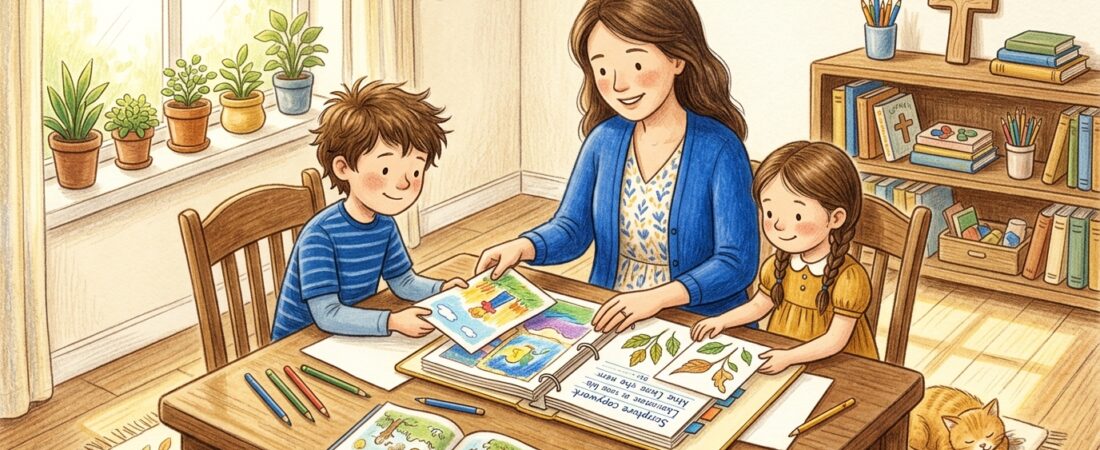
Why Every Christian Homeschool Family Needs a Portfolio
If you have ever felt unsure how to document your child’s progress, you are not alone. Building a homeschool portfolio is one of the most meaningful ways to capture your child’s academic and spiritual journey — and there are so many creative homeschool portfolio ideas for Christian families that go far beyond a simple folder of worksheets. Whether your children are toddlers just learning letters or elementary-aged kids diving into Bible history, a well-organized portfolio tells a rich story of growth, faith, and learning that you and your child will treasure for years to come.
Faith Filled Learning is reader-supported. When you buy through links on our site, we may earn an affiliate commission at no extra cost to you.
What to Include in a Christian Homeschool Portfolio
A great portfolio is more than a collection of graded papers. For Christian homeschool families, it is a record of how your child is growing academically, creatively, and spiritually. Here are the key categories to consider including:
Academic work samples: Choose three to five pieces per subject each semester that best represent your child’s skill level. This could include math worksheets, written narrations, spelling tests, or reading comprehension responses. You do not need to save everything — quality over quantity is the goal.
Faith and Bible work: This is the heart of a Christian portfolio. Include scripture copywork, Bible verse memorization lists, answers to catechism questions, or drawings inspired by Bible stories. If your family uses a dedicated Bible curriculum, tuck in completed lessons or project pages that reflect your child’s understanding of God’s Word.
Creative projects and art: Artwork, craft projects, nature drawings, and illustrated timelines are wonderful additions. These show creativity and often integrate multiple subjects at once. Consider a homeschool portfolio binder for kids with clear pocket sleeves to display artwork beautifully without damage.
Photos and documentation: Field trips to a Christian museum, science experiments, co-op presentations, and hands-on history projects are hard to put on paper — so photograph them! Print a few favorites and add captions in your child’s own words.
Reading logs and book lists: Keep a running list of books your child read or listened to throughout the year. For younger children, include picture book titles. For older kids, note chapter books and any titles with a faith-based theme.
Creative Homeschool Portfolio Ideas for Christian Families by Age
The format and content of your portfolio should grow with your child. Here is how to tailor it by age group:
Ages 2–4 (Toddlers and Preschoolers): Keep it simple and playful. Save handprint art, finger-painting projects, and early tracing or coloring pages. Include a few photos of sensory play, playdough creations, or a completed Bible coloring page. A small three-ring binder with a cheerful cover your child decorates themselves makes this age group feel proud of their work. Focus on documenting milestones like learning letter sounds, counting objects, or identifying Bible story characters.
Ages 5–7 (Kindergarten and Early Elementary): At this stage, children are beginning to read and write, so portfolios become more robust. Include early readers, phonics worksheets, number writing practice, and simple narrations dictated to you and then illustrated by your child. Nature journal pages are especially wonderful at this age — a Charlotte Mason nature study approach produces beautiful portfolio pieces naturally. Add a “spiritual growth” page where you record Bible verses your child memorized and any faith conversations that stood out to you.
Ages 8–12 (Upper Elementary): Older children can take ownership of their own portfolios. Teach them to select their best work, write brief reflections on what they learned, and organize sections by subject. Essays, history timelines, science lab reports, and creative writing pieces all shine here. This is also a great age to include a personal testimony or a journaling page where your child writes about how their faith is growing. If you are using a Christ-centered curriculum, completed unit projects from programs reviewed on sites like HSLDA can help you understand what documentation requirements may look like for your state.
How to Organize and Present Your Christian Homeschool Portfolio
Organization does not have to be complicated. Choose a system that fits your family’s personality and stick with it consistently. Here are a few practical formats that work well:
The Classic Binder Portfolio: Use a large three-ring binder divided into tabbed sections for each subject — Bible, Language Arts, Math, History, Science, and Art. Add a table of contents and a brief “about our homeschool year” introduction page at the front. This format is easy to update throughout the year and simple to present to evaluators if your state requires it. For a head start on keeping records organized, check out homeschool record keeping tips that pair perfectly with portfolio building.
The Digital Portfolio: Apps like Google Slides, Seesaw, or a private family blog let you upload photos, videos, and scanned documents. This is especially handy for families who do a lot of hands-on learning. You can organize posts or slides by month or by subject, and it doubles as a beautiful keepsake you can revisit each year.
The Memory Box Portfolio: For younger children especially, a decorative box or crate works wonderfully. Drop in artwork, photos, special assignments, and small keepsakes like a feather from a nature walk or a ticket stub from a field trip. At the end of the year, sort through the box together and choose favorites to move into a binder or scrapbook.
The Scrapbook or Lapbook Approach: Faith-based lapbooks and scrapbooks are a creative way to document unit studies. Your child assembles mini-books, foldables, and illustrated pages about topics they studied — from creation science to the life of a biblical hero. This is a beloved approach in many Charlotte Mason and classical homeschool communities. Pair it with a Christian homeschool lapbook kit to make the process even smoother.
No matter which format you choose, aim to update your portfolio at least monthly. Set aside fifteen minutes at the end of each week to pull out a few pieces worth keeping. Staying current makes the end-of-year review feel joyful rather than overwhelming. A homeschool planner for moms can help you schedule portfolio days right into your routine.
Weaving Faith Throughout Your Homeschool Portfolio
What makes a Christian homeschool portfolio truly unique is the intentional thread of faith woven through every section. Here are a few ideas to make your portfolio reflect your family’s beliefs and values:
Add a scripture theme for the year. Choose a family verse for the school year and write it beautifully on the cover page of each binder section. As your child grows, you will have a collection of yearly verses that document their spiritual journey alongside their academic one.
Include prayer journals or gratitude lists. Even young children can dictate or draw prayers. A short prayer journal tucked into your portfolio captures the heart of your home in a way no worksheet ever could.
Document acts of service. Did your children write cards to elderly neighbors, participate in a church food drive, or memorize scripture to share with a grandparent? These kingdom moments deserve a place in your portfolio. The Focus on the Family website offers wonderful guidance on raising children with a servant heart, which can inspire new portfolio sections around character and service.
Capture growth in character, not just academics. Write a brief parent narrative each semester — a paragraph or two describing how your child has grown not just as a learner, but as a person of faith. These narratives become treasures you will re-read for decades.
Frequently Asked Questions
Do I legally have to keep a homeschool portfolio?
It depends on your state. Some states require annual portfolio reviews or evaluations, while others have very few documentation requirements. Check your state’s specific homeschool laws before deciding how formal your portfolio needs to be. Regardless of legal requirements, most homeschool families find portfolios valuable for tracking progress and celebrating growth.
How do I choose which work samples to include in a portfolio?
Select pieces that show your child’s best effort, a significant improvement, or a memorable learning moment. Aim for variety — include written work, artwork, photos of projects, and faith-based activities. You do not need to include every assignment; three to five strong samples per subject each semester is plenty for most families.
What is the easiest way to start a homeschool portfolio from scratch?
Start with a simple three-ring binder and a handful of tabbed dividers. Label each section with a subject your child studies, add a cover page with your child’s name and school year, and begin dropping in completed work each week. Do not overthink it — even a basic binder started today is far better than a perfect system you never begin.
Can a portfolio work for a toddler or preschooler who is not doing formal school yet?
Absolutely! Preschool portfolios are some of the most charming ones you will ever create. Save handprint art, coloring pages, photos of sensory play, and dictated words or sentences. These early portfolios capture a season of learning through play that passes by so quickly and becomes deeply meaningful to look back on.
Start Building Your Portfolio Today
Building a homeschool portfolio does not have to feel like one more thing on an already full plate. When you approach it as a celebration of your child’s unique, God-given journey rather than a compliance task, it becomes one of the most rewarding parts of your homeschool year. Start simple, stay consistent, and let your family’s faith be the golden thread that runs through every page. Your children will look back on these portfolios and see not just what they learned, but how much they were loved — and how faithfully God guided your family through each season of learning together.
Ready to get more organized in your homeschool? Browse our homeschool record keeping resources and find the planning tools that fit your family best. You have got this, mama!
Printables & faith-filled tees from our shop
Bible coloring and activity books, alphabet printables and homeschool planners — instant download, print at home. Plus Comfort Colors tees for homeschool moms who get it.
Every purchase supports this blog and keeps our free resources free.