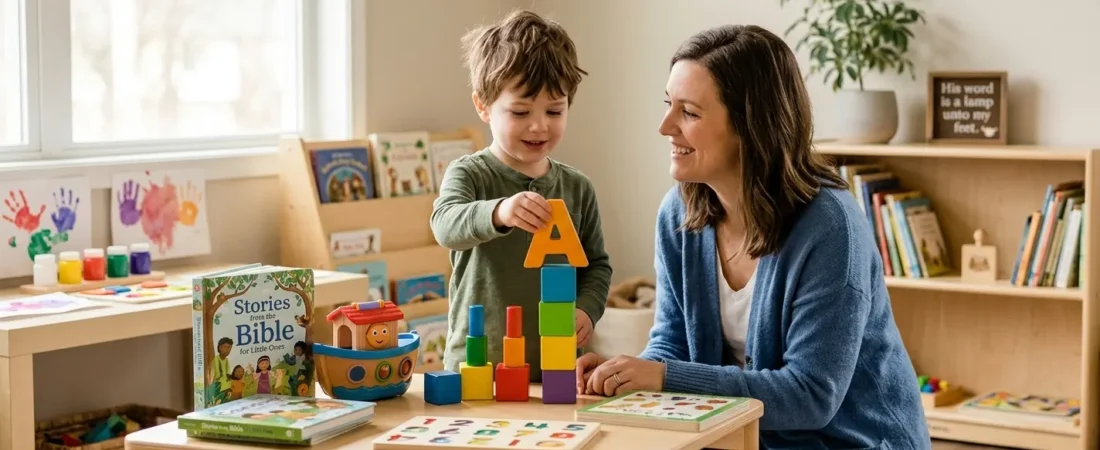
If you’ve decided to homeschool your child and they’re approaching preschool age, you’ve probably felt that moment where the peace you had about your decision suddenly gives way to a wave of doubt. Am I doing this right? What if I miss something? What if they fall behind? Take a breath. This guide is going to settle most of those fears before we’re done.
Faith Filled Learning is reader-supported. When you buy through links on our site, we may earn an affiliate commission at no extra cost to you.
Here’s the truth that most getting started guides won’t tell you: you’ve already been homeschooling since the day your child was born. Every time you hummed to soothe them, held them skin to skin, nursed them, rocked them, or pointed at something and said “look at that” — that was teaching. Christian homeschool preschool isn’t a dramatic shift from what you’ve already been doing. It’s just becoming more intentional about something that’s been happening naturally all along.
What Christian Homeschool Preschool Actually Looks Like
If you’re picturing a tiny desk, a lesson plan, and a clock on the wall, let that image go. At the preschool level — roughly ages 3 to 5 — there is no structured curriculum you need to follow. The most powerful classroom for a child this age is your everyday life.
Bring them with you. Take them to the grocery store and talk through what you’re doing. Let them help sort laundry by color. Read out loud at bedtime. Sing songs in the car. Go to a mommy-and-me class or a music class where they get to hear different sounds and interact with other kids. The learning is happening constantly — you don’t have to engineer it.
What you are working on at this stage is foundational character and life skills: sharing, not hitting, basic manners, learning to sit still for a few minutes, and getting comfortable with other children and adults. That is the real preschool curriculum, and most Christian families are already covering it through church, co-ops, play dates, and simply living life together.
The Fear Every Homeschool Parent Feels — and Why It’s Mostly Unfounded
The anxiety usually hits around the ages when society expects children to know certain things. You start comparing your child to what kids their age “should” know, and the worry creeps in that you’ve already fallen behind.
Here’s the reality: you are always working with your child wherever they are. That’s the whole point of homeschooling. There is no falling behind when the pace is set by your child. If something is slow to click, you stay with it until it does. If they’re racing ahead, you move with them. That flexibility is not a weakness of the homeschool model — it is its greatest strength.
Many homeschool families have five or six children, and not one of them follows the exact same path. Some are homeschooled all the way through and walk straight into college. Others might need more structure at a certain age, so a parent enrolls them for a year or brings in a reading tutor. The co-op and community around you will often recognize where a child is struggling long before it becomes a crisis, and there is always a next step available.
What Your Child Actually Needs to Know Before Kindergarten
If you want a simple, practical benchmark to work toward, use the basic kindergarten readiness list as your guide — not as a source of pressure, but as a destination that gives you direction.
- Potty trained and able to handle basic hygiene independently
- Knows basic manners — please, thank you, excuse me
- Can follow simple two-step instructions
- Recognizes letters, numbers, and basic colors
- Can sit and focus for short periods
- Plays appropriately with other children
That’s it. If your child can do most of those things by age five or six, they are right on track. Don’t panic if you’re not there yet — keep working, stay consistent, and trust the process. The beauty of homeschooling is that your child’s pace sets the pace. It will even out.
How Faith Gets Woven In at This Age
You don’t need a devotional curriculum to raise a faith-filled preschooler. At this age, children are mimicking everything they see and hear. They are watching you more than they are listening to you.
Go to church every week. Talk about God and Jesus naturally in your home — at the dinner table, before bed, when something beautiful happens outside. Pray out loud with them. Let faith be the air in your house, not a class on the schedule.
Children absorb what surrounds them. If you’ve ever watched a toddler set up a pretend pulpit, babble a sermon, and invite everyone to sit down — you know exactly what this looks like in action. They see what you do, they want to be like you, and they will imitate it. Be the example. That is your most powerful preschool curriculum.
Simple Activities That Actually Work at This Age
You don’t need elaborate lesson plans. The activities that work best at the preschool level are simple, tactile, and fun.
- Coloring pages — builds fine motor skills, focus, and creativity. Christian-themed coloring pages tie your faith naturally into the activity.
- Puzzles — problem solving, patience, and spatial reasoning without a single worksheet.
- Reading aloud together — every single day. It doesn’t matter what you read, just read.
- Counting in real life — birds in the yard, apples at the store, steps on the stairs. Real-world math beats flashcards every time.
- Songs and rhymes — language development, memory, and joy all in one.
One principle worth locking in early: talk to your child like the grade-level student you are working toward, not like a baby. Use real words. Explain things. Ask them questions and wait for an answer. The cognitive development that happens when a child is spoken to like an intelligent person — even at age three — is remarkable.
A Note on Unschooling
If you’ve heard the term unschooling and it either intrigued or terrified you, here’s a plain-language explanation: unschooling is a philosophy where there is no formal curriculum at all. Learning happens entirely through living life. No lesson plans, no workbooks, just intentional engagement with the world.
For the preschool years especially, this is closer to what most Christian homeschool families are naturally doing than they realize. The key word is intentional — unschooling doesn’t mean staying home all day. You have to get out. Take them places. Expose them to new experiences, people, sounds, and ideas. If children can learn and thrive without a formal curriculum in their early years — and they absolutely can — you are not going to ruin your child by not having a preschool lesson plan in place.
When Does Formal Curriculum Actually Start?
For most Christian homeschool families, the answer is around first grade. That is the point where you want to start thinking about lesson plans, identifying what your child should be covering, and building some structure into your days.
One curriculum we’ve used and trusted is Mother of Divine Grace. What sets them apart is the personal guidance — you work with an academic advisor who helps you select the right lessons based on your child’s interests, pace, and learning style. They can also tell you the expected daily seat time for each grade level based on the specific lessons you choose, which takes the guesswork out of structuring your days entirely.
One of the most freeing realizations for new homeschool parents is how little time formal instruction actually takes compared to traditional school. Where a building school day runs seven or eight hours plus homework, a well-structured homeschool day can cover everything it needs to in a fraction of that time. That’s not a bug — that’s the feature. Learning is efficient when it’s one-on-one.
And when the book work is done, the real learning begins. When your child works through a subtraction problem on paper, the lesson truly cements when you’re out walking and they watch one bird fly away from a group of three and do the math out loud without being asked. That connection between lesson and life is what homeschooling is built for.
You’re More Ready Than You Think
Christian homeschool preschool is not a program. It’s a posture. It’s deciding to be present, to bring your children into your daily life, to talk to them and read to them and pray with them and let them watch you live out your faith. The formal structure comes later. For now, the best thing you can do is relax, stay consistent, and trust that the foundation you’re building in these early years matters more than any curriculum ever could.
When you’re ready to explore printable resources to support your homeschool journey, our printable planners for homeschool moms and Christian homeschool curriculum guide for elementary kids are great next steps.
This article was written with the assistance of AI tools and reflects the personal experience and perspective of a Christian homeschooling family.
Printables & faith-filled tees from our shop
Bible coloring and activity books, alphabet printables and homeschool planners — instant download, print at home. Plus Comfort Colors tees for homeschool moms who get it.
Every purchase supports this blog and keeps our free resources free.