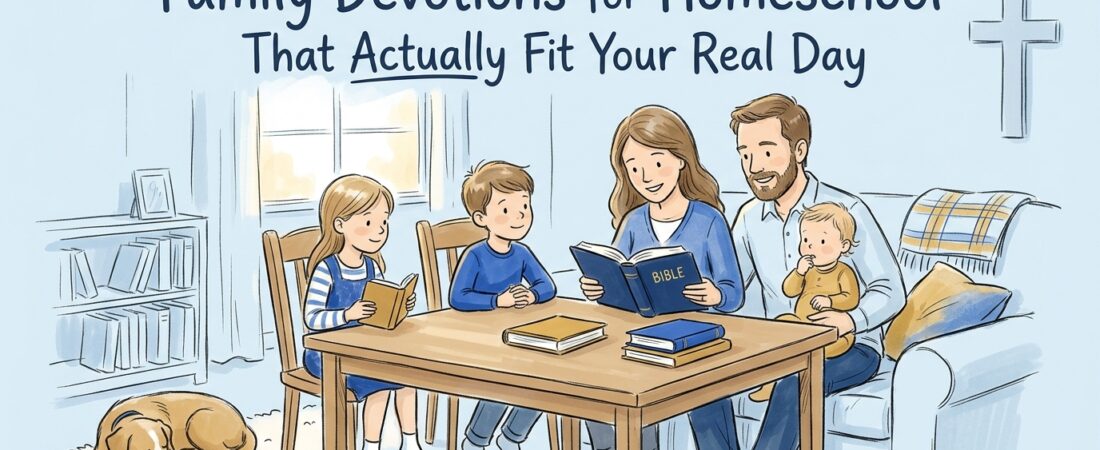
Family devotions for homeschool do not have to look like a formal church service at your kitchen table. They do not require a printed curriculum, a structured lesson plan, or a perfectly quiet house. What they require is you showing up consistently, opening the Word with your kids, and letting God do the rest. In our homeschool, devotions have looked like everything from ten minutes of Bible reading before math to a spontaneous conversation about forgiveness after a hard sibling moment. Both count. Both matter.
Faith Filled Learning is reader-supported. When you buy through links on our site, we may earn an affiliate commission at no extra cost to you.
Why Family Devotions for Homeschool Look Different for Every Family
One of the gifts of homeschooling is that we get to build our days around what actually works for our family. That includes devotions. Some families do best with a structured Bible curriculum that gives them a passage, a question, and a prayer prompt every morning. Others thrive on simply reading through a book of the Bible together a few verses at a time. Neither approach is wrong. What matters is that faith is not compartmentalized into a single checkbox on the schedule and then forgotten until Sunday morning.
In our homeschool, we went through a season where we tried to do devotions first thing every morning, and it just created stress. The toddler was melting down, the older kids were grumpy, and I was trying to talk about the fruits of the Spirit while also pouring cereal. It was not working. We shifted devotions to after breakfast, once everyone had eaten and settled, and everything changed. The conversations got longer. The kids started asking real questions. That small adjustment made more of a difference than any curriculum I could have purchased.
If you are looking for structured Bible content that works beautifully alongside devotion time, the resources at best Bible curriculum for homeschoolers can help you find something that fits your family’s rhythm and age range.
Simple Ways to Do Family Devotions When You Have Kids Ages 2 to 12
The wide age range is real. In many homeschool homes, you are sitting down with a two-year-old who wants to color, a seven-year-old who is starting to ask deep theological questions, and a preteen who is quietly listening to everything you say even when it does not look like it. Here is what has worked for us and for many moms in our community.
Read aloud from a children’s Bible or a read-aloud Bible storybook for the youngest ones. The two and three year olds do not need a lecture. They need to hear the names of Noah and David and Jesus spoken at home, in a warm voice, with pictures in front of them. You are planting seeds. You will not always see the sprout right away. For kids in this age range, our post on Bible stories for kids ages 2 to 6 has specific book recommendations we have actually used.
For the middle ages, six through ten, this is when kids start wrestling with real questions. Why did God let that happen? Is heaven real? Why do we pray if God already knows everything? Do not be afraid of those questions. They are a sign that your child is thinking, not a sign that something is going wrong. Sit with the question. Look it up together. Say out loud that you do not always have all the answers but you trust the One who does. That is discipleship happening right there at your table.
For the older kids, ten to twelve, let them start leading occasionally. Ask one of them to pick the passage for the week. Ask another to find a worship song that connects to what you read. Give them ownership. You will be surprised what they bring to the table when they feel trusted.
Keeping Family Devotions Consistent Without Making Them a Chore
Consistency is the whole game. A five-minute devotion done every single day for a year will do more for your children’s faith than a forty-five-minute family Bible study done three times and then quietly abandoned because it felt like too much. Start smaller than you think you need to. One passage. One question. One prayer. That is enough to begin.
We also keep a little notebook near our devotion spot where the kids can write or draw what they heard. It is not graded. It is not required every day. But it gives the kids something to do with their hands and it gives me a window into what they are actually absorbing. My daughter once drew a picture of Jesus with our family standing next to him after we read John 15 about abiding in the vine. She was six. I still have that drawing.
Worship music helps too. We often start or end with a song. It does not have to be anything elaborate. A familiar hymn on YouTube, a worship playlist, even just singing together without any accompaniment. Music gets into kids in a way that words alone sometimes cannot.
Focus on the Family has an excellent collection of family devotion guides and conversation starters specifically designed for kids at different ages, and it is worth bookmarking as a free resource: focusonthefamily.com.
Weaving Devotions Into the Rest of Your Homeschool Day
One of my favorite things about homeschooling is that the lines between subjects and life are blurry in the best possible way. When we read about the Israelites in history, we talk about God’s faithfulness. When we learn about the human body in science, we talk about being fearfully and wonderfully made. When we work through a hard math concept and a child gets frustrated, we talk about perseverance and what it means that God does not give up on us when we get things wrong.
This is not forced. It is just what happens when faith is the foundation of your home and not a separate add-on. The curriculum covers math and reading and writing. But you are covering everything else simply by living alongside your kids and being honest about what you believe and why.
If you are using a faith-integrated curriculum that already does some of this weaving for you, that can be a real help. Resources like My Father’s World are specifically designed to connect Bible, history, and literature in a way that reinforces faith throughout the school day rather than treating it as a separate subject.
When Devotions Feel Hard or Hollow
There will be seasons when family devotions feel dry. The kids are resistant. You are going through something hard yourself. You open the Bible and the words feel distant. That is not a sign that you are doing it wrong. That is just faithfulness in a hard season looking different than faithfulness in an easy one.
On those days, I have learned to say so out loud to my kids. I have told them more than once that I am having a hard time feeling close to God right now but that we keep showing up anyway because that is what faith looks like. Those honest moments have been some of the most important devotion times we have had. My kids saw that faith is not about feeling a certain way every morning. It is about coming back to the table even when it is hard.
Give yourself grace. A week of short, distracted devotions is not failure. It is a family doing their best in the middle of real life. Keep showing up. The Word does not return void, even when your kitchen is loud and someone is crying and you only made it through two verses before everything fell apart.
Getting Started With Family Devotions This Week
If you are not currently doing regular devotions and you want to start, do not wait until you have the perfect plan. Pick one passage for tomorrow morning. Read it out loud. Ask one question. Pray together, even if the prayer is short. That is your devotion. You just did it.
Build from there. Add a song. Add a journal. Add a memorization verse for the month. But start with the one thing and do it tomorrow. Your kids will remember that you opened the Bible with them far more than they will remember which curriculum you used or whether you hit every subject every day.
Family devotions for homeschool are not about being the most spiritually impressive mom in the room. They are about being present, being honest, and trusting that God works through ordinary faithful mornings. That is something every one of us can do.
Printables & faith-filled tees from our shop
Bible coloring and activity books, alphabet printables and homeschool planners — instant download, print at home. Plus Comfort Colors tees for homeschool moms who get it.
Every purchase supports this blog and keeps our free resources free.