Why Fractions Feel Hard and How You Can Change That
If you have ever wondered how to teach fractions at home, you are not alone. For many homeschool moms, fractions are the math topic that brings a few tears — sometimes from the kids, sometimes from us. But here is the encouraging truth: fractions do not have to be intimidating. When you strip away the anxiety and replace it with hands-on, real-life learning rooted in God’s good design of the world, fractions become one of the most concrete and even joyful math concepts you can teach. This guide walks you through practical strategies, curriculum ideas, and faith-filled encouragement to help your children ages 2–12 grasp fractions with confidence in 2026.
Faith Filled Learning is reader-supported. When you buy through links on our site, we may earn an affiliate commission at no extra cost to you.
Start with Real Life Before You Open a Workbook
Young children — even toddlers and preschoolers — are already living in a world full of fractions. A banana split in two, a pizza divided into eight slices, a granola bar broken in half to share with a sibling: these are all fraction lessons hiding in everyday moments. Before you ever write the number ½ on a whiteboard, let your children experience what a fraction is.
Here are a few ways to build that real-life foundation:
Cooking and baking: Measuring cups are fraction tools. Ask your child to pour ½ cup of oats or ¼ cup of honey. Talk about what those numbers mean as you bake together. This is especially powerful for kids ages 4–8 because they are touching and pouring and seeing the amounts.
Food cutting: Cut an apple into four equal pieces and talk about how each piece is one-fourth of the whole apple. Connect it to sharing — God calls us to be generous, and sharing equally is a great character lesson tucked right inside a math moment.
Lego and building blocks: If you have a set of ten blocks, ask your child to show you half. How many is that? Can they show you two-fifths? Manipulatives like these make abstract numbers tangible.
For children ages 2–4, the goal is simply the language: whole, half, equal parts. Do not rush into notation. Let them hear the words and see the concept repeatedly before any pencil meets paper.
How to Teach Fractions at Home Using Hands-On Manipulatives
Once your child has a real-life foundation, it is time to introduce tools that bridge the gap between concrete experience and abstract math. Manipulatives are essential, and in 2026 there are more wonderful options than ever.
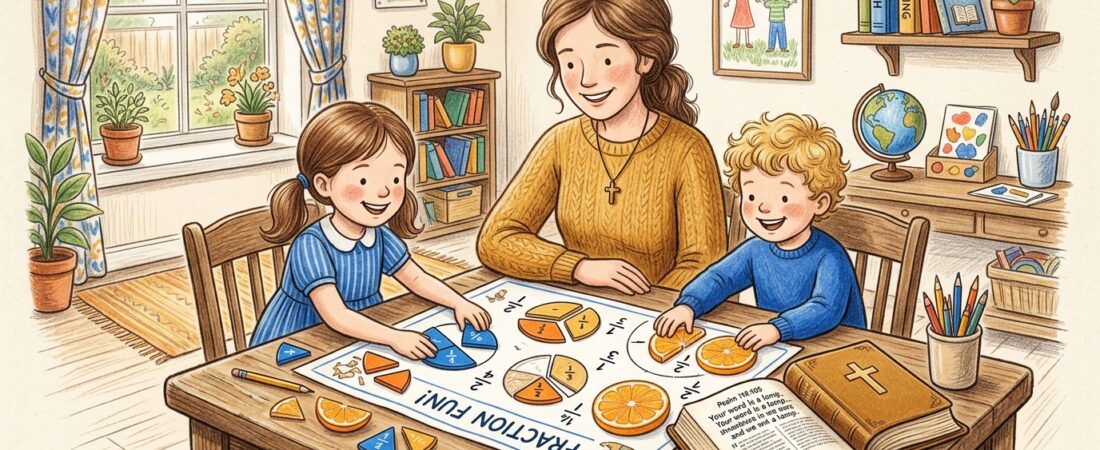
Fraction tiles and circles: These colorful pieces let children physically layer fractions to see that two one-fourths equal one-half. Fraction tiles manipulatives are a staple in many homeschool rooms and are well worth the small investment.
Fraction number lines: A number line stretched across a piece of poster board or taped on the floor gives children a visual reference. Have your child walk the number line, jumping from 0 to ½ to 1. Kinesthetic learners thrive with this activity.
Paper folding: Hand your child a square piece of paper and ask her to fold it in half. Then fold it again. Open it up — now she can see four equal parts. Label each part ¼. Simple, free, and effective.
Playdough fractions: Roll out a playdough snake and ask your child to cut it into three equal pieces. Each piece is one-third. This works beautifully for ages 4–7 and keeps little hands busy while big ideas click into place.
For a thorough look at math curricula that incorporate hands-on learning from a Christian perspective, check out our guide to Christian homeschool math curriculum — it covers options from preschool through upper elementary and beyond.
Choosing the Right Curriculum and Resources
One of the best decisions you can make as a homeschool mom is to choose a curriculum that teaches fractions sequentially and with plenty of visual support. Here are a few approaches that work well across different learning styles.
Charlotte Mason-style math: If you follow a Charlotte Mason philosophy, you will want to keep lessons short — around 15 to 20 minutes — and always begin with living examples before moving to abstract symbols. Narration and real-world application are central. You can explore this approach further in our Charlotte Mason homeschool guide.
Mastery-based curricula: Programs that teach one concept deeply before moving on are ideal for fractions because the topic builds on itself. A child who does not understand equivalent fractions will struggle with adding unlike denominators later. Look for curricula with built-in review spirals.
Workbooks for extra practice: Sometimes a child just needs more repetition. A well-designed workbook like a fraction workbook for elementary students can fill in gaps without requiring you to design extra lessons from scratch.
Online support: Khan Academy offers free fraction lessons and exercises that work well as a supplement for ages 7 and up. It is not a replacement for a full math curriculum, but it is an excellent free tool for days when you need a lighter approach.
Whatever curriculum you choose, remember that consistency matters more than perfection. A short daily fraction lesson — even ten minutes — will produce more lasting results than one long, stressful session each week.
Fraction Games and Faith-Connected Activities for Kids Ages 5–12
Games are one of the most underused tools in homeschool math, and they are particularly effective for fractions because they take the pressure off while still requiring a child to think carefully.
Fraction War (card game): Use a deck of cards to create fraction flashcards. Flip two cards each and form a fraction — higher number on the bottom as the denominator. Compare your fraction to your opponent’s. Whoever has the larger fraction wins the round. Kids ages 7–12 love the competitive element, and they are building number sense the entire time.
Fraction Bingo: Create simple bingo cards with fractions written in each square. Call out visual representations — “two out of four equal parts” — and let kids find the matching fraction on their card. You can make this yourself with index cards and a marker in about ten minutes.
Bible story fractions: Connect fractions to Scripture stories to bring them alive spiritually. When studying the feeding of the five thousand, ask: if Jesus started with 5 loaves and 2 fish, what fraction of the crowd could each loaf feed if divided equally among 1,000 people? For older kids ages 9–12, this sparks both mathematical thinking and faith-filled wonder at God’s miraculous provision.
Stewardship fraction lessons: Teach tithing through fractions. If we have 10 coins, one-tenth belongs to God. That is a real, meaningful fraction lesson rooted in biblical truth. Children who learn math inside a framework of faith tend to engage more deeply because the knowledge has purpose beyond the test page.
If you find yourself teaching multiple children across different ages and grade levels, our article on teaching multiple ages at once in your homeschool offers practical strategies for keeping everyone learning without burning yourself out.
Troubleshooting Common Fraction Struggles
Even with the best lessons and the most patient teaching, some children hit a wall with fractions. Here are the most common stumbling blocks and how to work through them.
“The bigger the number on the bottom, the smaller the piece” confusion: This trips up almost every child at first. It feels backwards. Go back to food — cut one sandwich into 2 pieces versus 8 pieces. Hold both up. Ask which piece is bigger. The visual almost always resolves the confusion faster than any explanation.
Equivalent fractions: Use fraction tiles to physically show that two ¼ pieces fit perfectly on top of one ½ piece. Repeat this hands-on comparison many times before expecting a child to compute equivalent fractions on paper. The concept must be seen before it is calculated.
Adding fractions with unlike denominators: This is a late elementary skill, typically introduced around ages 9–11. Do not rush it. Make sure your child is fluent with equivalent fractions and comfortable with basic fraction vocabulary before you introduce this step. When you do introduce it, use fraction tiles and color-coded visual models before moving to the algorithm.
Math anxiety: Some children become genuinely fearful around math. If this is happening, slow down. Go back to purely hands-on activities. Remove the pencil and paper entirely for a week. Play games. Cook together. Pray together before lessons. A calm, unhurried environment shaped by grace will always outperform a hurried push through a textbook.
For children who struggle more broadly with math facts, our post on how to teach math facts to struggling kids may give you additional tools and encouragement.
Frequently Asked Questions
At what age should I start teaching my child fractions?
You can introduce fraction language — words like half, whole, and equal parts — as early as age 2 or 3 through everyday activities like cutting fruit or sharing snacks. Formal fraction instruction with symbols and written work typically begins around age 6 or 7, but there is no rigid rule. Follow your child’s readiness rather than a strict grade level.
What if my child understands fractions in real life but struggles on paper?
This is very common and actually a good sign — it means the conceptual foundation is there. Bridge the gap by drawing pictures of what your child already understands. Ask her to draw a pizza cut into four slices and shade one, then write the fraction below it. Connect the symbol to the picture consistently before expecting abstract computation.
Do I need to buy a separate fractions curriculum or can I teach it within our regular math program?
Most solid math curricula cover fractions within their scope and sequence, so you likely do not need a separate program. However, if your child needs extra practice or your current curriculum moves too quickly, a dedicated fraction workbook or a free resource like Khan Academy can supplement what you are already doing without replacing it entirely.
How long should a fraction lesson be for a young child?
For children ages 4–7, aim for 10 to 15 minutes of focused instruction. For ages 8–12, lessons of 20 to 30 minutes are appropriate. Shorter, consistent lessons produce better retention than long, sporadic sessions. If your child is frustrated, it is always okay to stop early, take a break, and return the next day with fresh eyes and a prayer for patience.
Money is another natural way to practice fractions and decimals; our guide to teaching money math at home has simple, real-life activities.
You Can Do This, Mama
Learning how to teach fractions at home is not about being a math expert — it is about being a faithful, creative, and patient guide for your child. God has equipped you to do this work. You do not need a perfect lesson plan every day. You need real fruit cut in half, a willing heart, and the conviction that the education happening in your home matters deeply for eternity.
Start where you are. Use what you have. Bring fractions into your kitchen, your Bible lessons, your games, and your conversations. And when a hard day comes — because hard days do come — remember that you are not just teaching math. You are building a child who knows how to learn, how to persevere, and how to trust that God is present even in the middle of a tricky fraction problem.
If you are looking for more ways to strengthen your homeschool math approach this year, explore our full guide to Christian homeschool math curriculum and find the right fit for your family’s style, budget, and goals. You’ve got this!
Printables & faith-filled tees from our shop
Bible coloring and activity books, alphabet printables and homeschool planners — instant download, print at home. Plus Comfort Colors tees for homeschool moms who get it.
Every purchase supports this blog and keeps our free resources free.