Why Spring Is the Perfect Season for Nature Study in Your Homeschool
If you are looking for engaging spring nature study activities for kids, you have landed in exactly the right place. Spring is a season bursting with life — budding trees, returning birds, blooming wildflowers, and busy insects — making it the most natural classroom God ever designed. For Christian homeschool families, this season is a beautiful reminder of renewal and creation, and it gives children ages 2 through 12 a front-row seat to the wonders described in Psalm 104. Whether your little ones are toddlers chasing butterflies or older kids building a detailed field journal, spring offers something meaningful for every age.
Faith Filled Learning is reader-supported. When you buy through links on our site, we may earn an affiliate commission at no extra cost to you.
Nature study does not have to be complicated or expensive. With a little planning and a heart of wonder, your backyard, a nearby park, or even a windowsill garden can become the richest science lesson of the year. Below you will find practical, faith-centered ideas to help your family dive into spring with curiosity and joy.
Spring Nature Journaling for Every Age
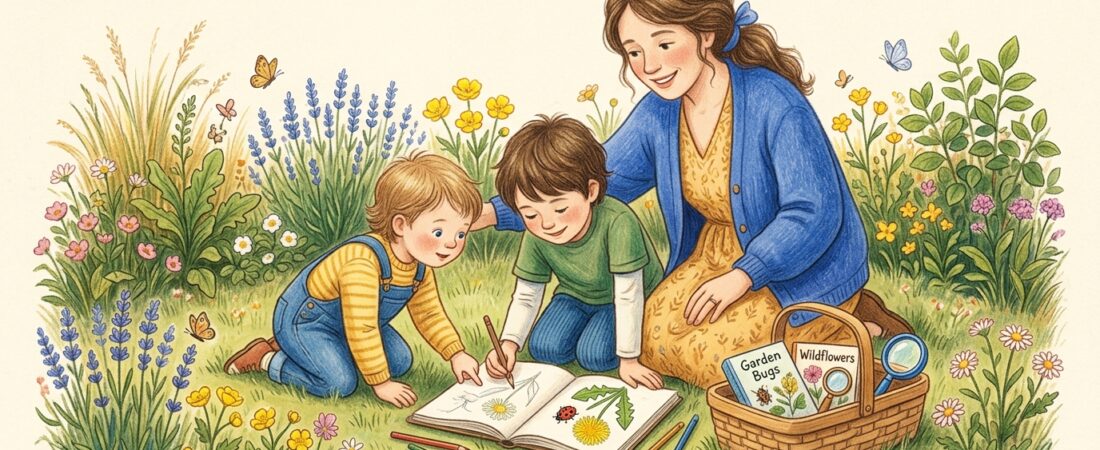
One of the most timeless spring nature study activities for kids is keeping a nature journal. Rooted in the Charlotte Mason nature study tradition, nature journaling invites children to slow down, observe carefully, and record what they see through drawing, painting, or writing. This practice builds scientific observation skills while also nurturing gratitude for God’s handiwork.
For toddlers and preschoolers (ages 2–5), keep it simple. Glue a pressed flower or leaf onto a page and let them scribble their impressions with crayons. For elementary children (ages 6–12), encourage more detailed sketches with labels — the parts of a flower, the stages of a butterfly’s life cycle, or the features of a bird they spotted. Consider picking up a copy of Keeping a Nature Journal by Clare Walker Leslie to guide older children in developing this beautiful habit.
You can also check out our dedicated guide to nature journaling for kids in the Christian homeschool for even more inspiration and printable ideas.
Set aside a regular “nature journal time” two or three mornings a week. Even fifteen minutes of focused outdoor sketching can sharpen a child’s powers of observation more than an hour of screen-based learning. Pair it with a short scripture reading about creation to anchor the experience in faith.
Hands-On Spring Nature Study Activities for Kids Outdoors
Getting outside is the heart of any good spring nature study. Here are several hands-on activities that work beautifully across a wide age range:
Backyard Bird Watching: Spring is migration season, and your yard or a nearby park will fill with returning species. Print a simple bird checklist from your region and let kids mark off every new bird they spot. Invest in a beginner bird field guide — National Audubon Society Field Guide to Birds is a wonderful reference to keep on hand. Discuss how God gave each bird its unique song and color as a reminder of His creativity (Matthew 6:26).
Flower and Plant Identification Walks: Take a slow walk and challenge kids to identify five different wildflowers or plants. Young children can sort plants by color while older kids press specimens and label them in their journals. This is a perfect activity to pair with a plant life-cycle lesson.
Bug and Insect Study: Ants, earthworms, ladybugs, and caterpillars are everywhere in spring. Give each child a magnifying glass and a small container for a temporary, close-up look at insects. Talk about how even the tiniest creature reflects God’s attention to detail (Proverbs 6:6). Always release the creatures after observation.
Pond or Stream Exploration: If you have access to a local creek or pond, let kids observe tadpoles, water skimmers, and aquatic plants. Bring nets, boots, and a clear container so children can get an up-close look before returning everything to the water.
For a comprehensive list of outdoor learning ideas beyond spring, visit our resource on outdoor learning activities for homeschool kids.
Integrating Science and Faith in Your Spring Unit Study
Spring nature study is a natural launchpad for a full unit study that weaves together science, scripture, art, and even writing. For Christian homeschool families, the goal is not just scientific knowledge — it is a growing awe of the Creator behind all creation.
Consider building a two- to four-week spring unit around a single theme such as pollinators, seeds and growth, or the water cycle. Anchor each week with a key scripture — Genesis 1, Psalm 19, or Job 12:7-10 are especially rich. Use living books, hands-on experiments, and narration to cover the scientific content.
The best Christian homeschool science curriculum options often include built-in nature study components, so check whether your current curriculum already has spring resources you can use. Publishers like Apologia produce faith-based science resources specifically designed to help children see the hand of God in every branch of natural science — their elementary zoology and botany sets pair beautifully with spring nature walks.
For your unit study, consider adding a simple planting project. Give each child a small pot and seeds — sunflowers, beans, or herbs work wonderfully — and track growth in the nature journal. Connect the parable of the sower (Matthew 13) to the lesson, and watch faith and science grow side by side.
Spring Nature Study for Toddlers and Preschoolers
Nature study for your youngest learners (ages 2–5) should be almost entirely sensory and play-based. In 2026, many homeschool moms are embracing the idea that toddlers learn best through unstructured time in creation rather than formal lessons — and the research strongly supports this approach.
Here are simple spring activities perfect for little ones:
Mud Kitchen Play: Set up a simple outdoor mud kitchen with old pots, spoons, and water. Digging in soil introduces children to earthworms, roots, and basic concepts of living versus nonliving things in a completely natural way.
Sensory Nature Basket: Fill a basket with spring treasures — a pinecone, a smooth pebble, a flower petal, a small branch with buds. Let toddlers touch, sort, and explore each item while you narrate what they are holding: “This is a soft petal from a tulip. God made it pink!”
Puddle Stomping and Rain Observation: Spring rain is a gift. Let kids stomp in puddles, then talk about where rain comes from and how it helps plants grow. Even a two-year-old can begin to understand that “God sends the rain” (Job 5:10).
For more structured ideas on teaching your littlest learners, our guide on how to homeschool a toddler and preschooler offers encouragement and a realistic daily rhythm you can follow.
Frequently Asked Questions
How do I start a nature study if I have no science background?
You do not need to be a scientist to lead a wonderful nature study. Start with simple observation walks, a basic field guide, and a notebook. Your job is to ask good questions — “What do you notice? What does it remind you of? What do you wonder?” — and learn alongside your children. The wonder matters far more than the expertise.
What supplies do I actually need for spring nature study activities for kids?
You can start with almost nothing: a notebook, some pencils, and your backyard. As you grow, a magnifying glass, a simple field guide for your region, and watercolor pencils for journaling are lovely additions. A good pair of rubber boots and a small net open up stream and pond exploration beautifully.
How do I keep multiple ages engaged in the same nature study activity?
Assign age-appropriate tasks for the same outing. A four-year-old can collect pretty rocks while a ten-year-old sketches and labels a plant specimen. Use the same nature walk to spark different levels of conversation and journaling. Shared experiences with individual expectations keep everyone engaged without overwhelming you.
Can nature study count toward our homeschool science requirements?
Absolutely. Nature study covers core science skills including observation, classification, hypothesis, and documentation. Keep samples of nature journal pages and note the concepts covered — life cycles, ecosystems, plant biology, animal behavior — and these can be recorded as part of your science curriculum for the year. Check your state’s homeschool requirements for specifics on documentation.
Bring God’s Creation Into Your Homeschool This Spring
Spring is short, sweet, and overflowing with learning opportunities that no textbook can fully replicate. The best spring nature study activities for kids are the ones that get your children outside, slow them down, and help them see the fingerprints of God on every petal, wing, and raindrop. You do not need a perfect plan — you just need a willing heart and a door to open.
Start small this week. Take a fifteen-minute walk, pick up a simple journal, and ask your children what they notice. Let the season do its work. As your family grows in the habit of observing creation, you will find that nature study becomes one of the most beloved and spiritually rich parts of your homeschool year.
Ready to go deeper? Explore our full guide to Charlotte Mason nature study for a rich philosophy and practical framework that will carry your family through every season — not just spring. And if you are looking for ways to keep outdoor learning going all year long, bookmark our outdoor learning activities for homeschool kids page for ongoing inspiration. Happy exploring, mama — God has already prepared the classroom. You just have to step outside.
Printables & faith-filled tees from our shop
Bible coloring and activity books, alphabet printables and homeschool planners — instant download, print at home. Plus Comfort Colors tees for homeschool moms who get it.
Every purchase supports this blog and keeps our free resources free.