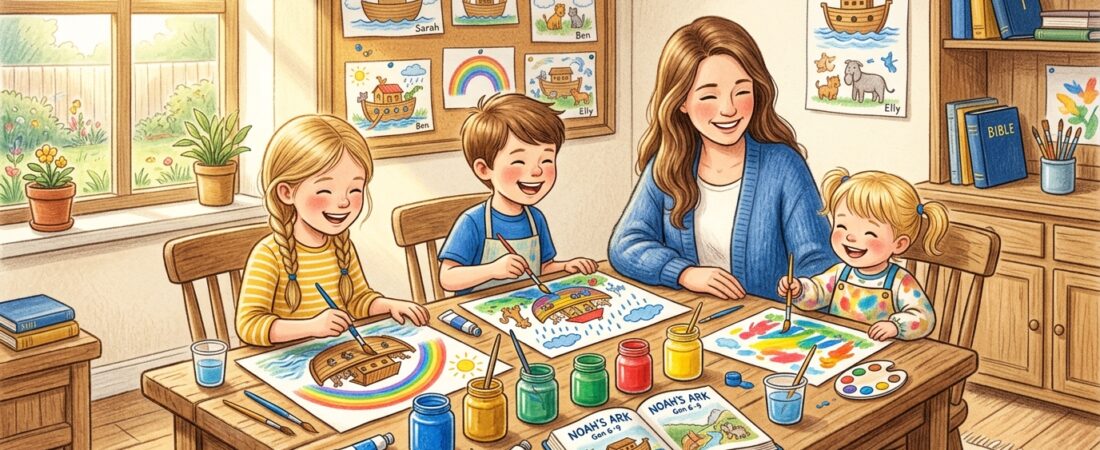
Why Bible Based Homeschool Art Projects for Kids Belong in Your School Day
If you are looking for a beautiful way to weave Scripture into your daily routine, bible based homeschool art projects for kids are one of the most joyful and effective tools in a Christian homeschool mom’s toolkit. Art has a unique way of helping children internalize stories, truths, and verses in a way that worksheets simply cannot. Whether your child is two or twelve, creating something with their hands while hearing God’s Word spoken aloud plants seeds that last a lifetime. In 2026, more Christian homeschool families than ever are discovering that art is not a “fun extra” — it is a meaningful, Scripture-saturated subject all on its own.
Faith Filled Learning is reader-supported. When you buy through links on our site, we may earn an affiliate commission at no extra cost to you.
The Benefits of Integrating Art and Scripture for Young Learners
Children learn through all of their senses, and art engages nearly every one of them. When a four-year-old tears tissue paper to create a colorful stained-glass butterfly during a lesson on God’s creation, she is not just making a craft — she is experiencing wonder. When a ten-year-old carefully maps out the Israelites’ desert journey with watercolors, he is building a mental picture of that story that sticks.
The benefits of combining Bible study with art go far beyond keeping kids busy. Research from early childhood education experts at NAEYC consistently shows that creative, hands-on learning supports language development, fine motor skills, and memory retention in young children. For Christian homeschoolers, that means your little ones are growing spiritually and developmentally at the same time.
Art also naturally accommodates multiple ages. A two-year-old can finger-paint a rainbow during a Noah’s Ark lesson while a nine-year-old illustrates a detailed comic strip of the same story. That is a huge win when you are teaching multiple ages at once.
Bible Based Homeschool Art Projects for Kids by Age Group
Matching the project to the child’s developmental stage makes all the difference between a frustrating afternoon and a joyful one. Here is a simple breakdown to help you plan.
Ages 2–4: Simple Sensory and Stamping Projects
Toddlers and preschoolers thrive with big, bold, sensory-friendly projects. Try sponge-stamping hearts on paper while talking about how God loves us, or finger-painting a yellow sun while learning that God is light. Dot markers are especially wonderful at this age — they require minimal fine motor control but produce colorful, satisfying results. A set of Do a Dot Art Markers is a staple in many Christian homeschool preschool spaces and pairs perfectly with simple Bible coloring sheets. You can find free printable options at Bible coloring pages for kids to get started right away.
Ages 5–7: Collage, Watercolor, and Story Illustration
Early elementary children can begin to represent specific Bible stories through their artwork. Watercolor resist art is a crowd favorite at this age. Have your child write a Bible verse in white crayon on watercolor paper, then brush over it with paint — the words magically appear. Collage projects using torn paper, fabric scraps, and nature items are also perfect for retelling stories like the Good Samaritan or Daniel in the Lion’s Den.
Ages 8–12: Illuminated Letters, Murals, and Sketchbook Journaling
Older children can take on more complex, intentional projects. Illuminated manuscript letters — inspired by medieval monks who decorated Scripture by hand — are a gorgeous project for this age group. Nature journaling with a faith focus is another rich option; pairing outdoor observation with written Scripture references teaches children to see God’s hand in creation. Explore the idea further through nature journaling for kids in a Christian homeschool. A dedicated hardcover blank sketchbook for kids gives older students a beautiful place to develop their Bible art portfolio over time.
Favorite Bible Stories to Inspire Art Projects in 2026
One of the easiest ways to plan your art calendar is to align projects with the Bible stories you are already studying. Here are some of the most art-rich stories and project ideas to match them.
Creation (Genesis 1–2): Seven-panel accordion books, one panel per day of creation, are a wonderful multi-day project. Children can use different media for each panel — crayons one day, watercolor the next, collage the next. This works beautifully for a full week of school.
Noah’s Ark (Genesis 6–9): Build a shoebox ark and decorate it with paint and clay animals. Younger children can finger-paint rainbow strips on black paper to represent God’s covenant promise.
The Psalms: Choose a short psalm and have children illustrate it, one verse per page, creating a handmade Scripture book they can give as a gift. Psalm 23 is especially beloved by young children and lends itself to lush nature-inspired artwork.
The Birth of Jesus (Luke 2): Salt dough nativity figures are a classic for a reason. Children of all ages can participate, and the figures become cherished keepsakes. Salt dough is inexpensive and forgiving, making it ideal for busy homeschool moms.
The Armor of God (Ephesians 6:10–18): Older children love designing their own armor of God poster or creating individual pieces — a sword, shield, and helmet — out of cardboard and aluminum foil. This becomes a memorable hands-on lesson in Scripture memorization as well.
If you are looking for a structured curriculum to guide your Bible art lessons, the best homeschool art curriculum for kids includes several faith-integrated options worth exploring.
Supplies to Keep on Hand for Bible Art Days
One reason many homeschool moms avoid art is the preparation overwhelm. The good news is that a simple, well-stocked art drawer makes spontaneous Bible art projects easy. Here is a basic list to build over time.
Painting supplies: Washable tempera paint, watercolor sets, and foam brushes in multiple sizes cover most projects from toddler to tween. A quality Crayola washable tempera paint set is affordable, non-toxic, and available in a wide range of colors ideal for creation-themed and story-based artwork.
Paper: Stock up on watercolor paper, cardstock, and large construction paper. Having different sizes and textures on hand gives children creative freedom.
Adhesives and extras: A good glue stick, a bottle of Mod Podge, tissue paper, fabric scraps, and natural items like dried leaves and twigs round out a well-equipped art space.
For even more free and low-cost resources to supplement your art days, check out free homeschool resources for Christian families — many of which include printable templates perfect for Bible art projects.
Master Books also publishes a number of faith-based art and drawing guides that integrate Scripture beautifully. Browse their catalog at Master Books for ideas that fit a Christian worldview.
Frequently Asked Questions
Do I need to be artistic myself to lead Bible art projects with my kids?
Not at all. The goal of Bible based art projects is not to produce museum-quality work — it is to help your children engage with Scripture through creativity. Simple projects like coloring pages, collages, and finger painting require no artistic skill from you. Your enthusiasm and willingness to create alongside your children matters far more than technical ability.
How do I fit art into an already full homeschool day?
Bible art does not need its own dedicated block of time every day. Many homeschool moms weave art into their existing Bible or history lessons two or three times per week. Even a 15-minute painting or drawing activity at the end of a Bible story lesson can make a significant impact. Starting with a morning basket that includes a simple art prompt is a low-pressure way to begin.
What if my child has sensory sensitivities and does not like getting messy?
Many children are texture-sensitive, and that is completely okay. Offer alternatives like colored pencils, markers, or oil pastels instead of paint. Collage with pre-cut paper pieces, sticker art, and stamping are also great options that keep hands clean while still producing beautiful, meaningful work. The heart of the project is the Scripture connection, not the medium.
At what age can kids start doing Bible art projects independently?
Most children ages 6 and up can work somewhat independently on simple art projects once they understand the process. By age 8 or 9, many children can read a Bible passage, choose their favorite moment from the story, and illustrate it with minimal guidance. Younger children, ages 2 to 5, benefit most from working side by side with a parent or older sibling who narrates the Bible story while they create.
Start Creating Faith-Filled Masterpieces Today
Bible based homeschool art projects for kids are one of the most natural, joyful ways to help your children fall in love with Scripture. You do not need a perfect art room, an expensive curriculum, or a fine arts degree. You need a willing heart, a few basic supplies, and the boundless inspiration found in God’s Word. Start small — pick one story, one medium, and one afternoon this week. Watch what happens when your child’s hands get busy and their heart gets full.
If you are ready to go deeper with your art education, explore structured faith-integrated options and let your homeschool art days become some of the most treasured memories of your children’s childhood. The masterpiece God is painting in their hearts is worth every paint-stained table and glitter-covered floor.
Printables & faith-filled tees from our shop
Bible coloring and activity books, alphabet printables and homeschool planners — instant download, print at home. Plus Comfort Colors tees for homeschool moms who get it.
Every purchase supports this blog and keeps our free resources free.