What Is a Commonplace Book and Why Does It Matter for Homeschool?
Learning how to use a commonplace book in homeschool can quietly transform the way your children engage with ideas, Scripture, and the world around them. A commonplace book is simply a personal notebook where a learner collects quotes, passages, illustrations, prayers, nature sketches, and anything else that strikes them as beautiful or worth remembering. Far from being a worksheet or a test, it is a living record of a growing mind and heart. For Christian homeschool moms, this practice is both timeless and deeply meaningful because it trains children to pay attention, to treasure truth, and to return again and again to what matters most.
Faith Filled Learning is reader-supported. When you buy through links on our site, we may earn an affiliate commission at no extra cost to you.
The Roots of Commonplace Books in Classical and Charlotte Mason Homeschooling
The tradition of keeping a commonplace book stretches back centuries. Scholars, theologians, and poets kept them as a way to gather wisdom from their reading in one accessible place. In the homeschool world today, this practice is closely associated with the Charlotte Mason homeschool method, which encourages children to copy living ideas from living books rather than passively consuming dry textbooks. Charlotte Mason herself believed that a child’s mind was not a vessel to be filled but a fire to be kindled, and the commonplace book is one of the most practical tools for doing exactly that.
The classical homeschool tradition also embraces this habit. Organizations like Classical Conversations emphasize the importance of gathering and organizing knowledge, and a commonplace book fits beautifully within that framework. Whether you lean Charlotte Mason, classical, or eclectic, this one simple notebook can thread through every subject your family studies in 2026 and beyond.
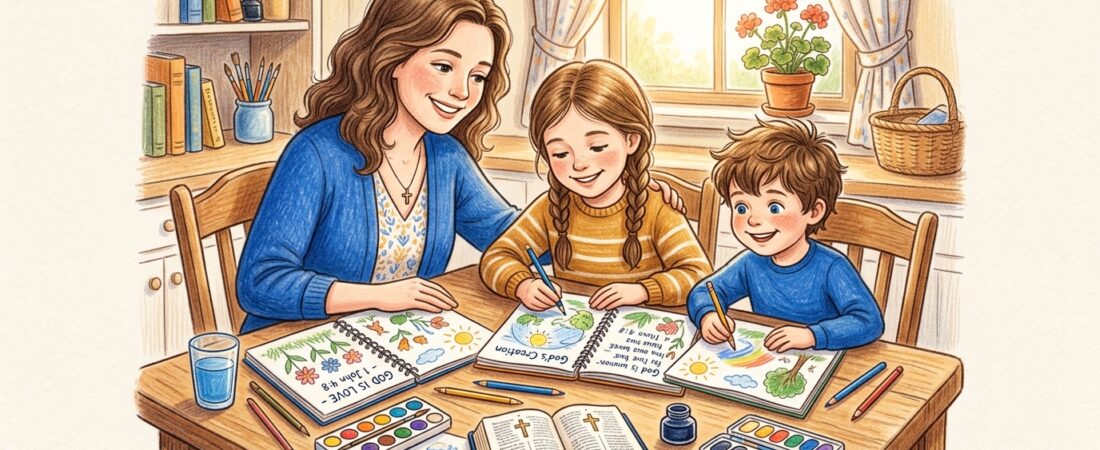
For younger children ages two through five, the commonplace book looks more like an illustrated scrapbook. A parent can do the writing while the child draws a picture of a Bible story they loved or pastes in a leaf from a nature walk. For children ages six through twelve, the child begins to do more of the writing themselves, copying verses, favorite lines from read-alouds, or narrations of what they learned in history or science. The key is to make it personal, not performative.
How to Use a Commonplace Book in Homeschool Across Every Subject
One of the greatest gifts of the commonplace book is its flexibility. It does not belong to any single subject. Instead, it weaves across everything your family is already doing, which means it adds depth without adding stress to your school day.
Bible and Faith: This is often the most natural starting place for a Christian homeschool family. Encourage your children to copy a memory verse at the top of a new page each week. You can also add lines from hymns, prayers they have written themselves, or a sketch that illustrates a parable. If you are looking for ideas to complement this practice, our guide on scripture memorization tips for kids pairs wonderfully with commonplace book keeping.
History and Literature: When your family reads aloud from a history book or a classic novel, pause and ask your child what line or idea they most want to keep. Let them copy it by hand. Handwriting a sentence someone else wrote is a powerful way to absorb its rhythm and meaning. You might be surprised which lines your children choose. A nine-year-old might copy a quote from Abraham Lincoln while her five-year-old brother draws a picture of a covered wagon on the opposite page. Both entries are valid. Both matter.
Nature Study: A commonplace book makes a wonderful companion to nature journaling. After a walk, children can sketch a bird they spotted, press a small flower between the pages, or copy a line from a nature poem. Our article on nature journaling for kids in Christian homeschool gives you even more practical ideas to bring the outdoors into your learning.
Writing Development: Copying excellent sentences trains a child’s ear for good writing better than almost any formal grammar exercise. Over time, children who keep commonplace books naturally begin to write with more variety and confidence because they have internalized the patterns of writers they admire. This makes the commonplace book one of the most quietly powerful tools in your homeschool writing toolbox.
Choosing the Right Notebook and Getting Started in 2026
The notebook itself does not need to be fancy, but it does need to feel special enough that your child wants to return to it. A plain composition notebook works beautifully and lets children decorate the cover themselves. For families who want something a little more beautiful right from the start, a blank hardcover journal for kids gives a sense of occasion that motivates young writers. You can also find lovely dot-grid notebooks that work well for both writing and sketching.
To get started, simply sit down together and make the first entry as a family. Mom can model by writing her own favorite verse or a line from a book she loves. Then invite each child to choose something they want to keep. There is no wrong answer. The only rule is that it must be something they genuinely love or find interesting, not something they think they should write.
From there, aim for two or three commonplace book entries per week rather than daily. Keeping the practice light and joyful ensures that children will carry it forward naturally rather than treating it like another assignment to check off. You might set aside fifteen minutes on Monday, Wednesday, and Friday mornings, or fold it into your morning basket time if you use one.
For a beautiful resource that already incorporates copywork in the spirit of a commonplace book, consider Simply Charlotte Mason copywork books, which offer Scripture and classic literature passages perfectly sized for young copyists. The team at Simply Charlotte Mason has also written extensively about narration and copywork practices that integrate seamlessly with keeping a commonplace book.
Tips for Keeping It Going When Motivation Fades
Every homeschool mom knows the rhythm of enthusiasm followed by a quiet slump. The commonplace book is not immune to this pattern, but a few simple strategies can keep the practice alive across an entire school year.
First, keep the books visible. A notebook stored in a drawer is a notebook that gets forgotten. Display them on a shelf in your learning space where children can flip through them during free time. Watching their own collections grow is one of the best motivators there is.
Second, celebrate the books occasionally. Set aside time once a month to read entries aloud to each other. Let children share their favorite addition from the past few weeks. This small ritual reinforces that what they are collecting matters and is worth sharing.
Third, tie the books to your current unit study or read-aloud. When there is a natural connection between what you are reading and what goes in the book, the entries feel purposeful rather than like a separate chore. If your family is studying ancient history, for example, encourage entries about famous figures or proverbs from that era. This approach works especially well if you use homeschool unit studies as part of your regular rhythm.
Finally, keep your own commonplace book alongside your children. When they see you treasuring ideas and writing things down for yourself, they understand that this is not just a school exercise. It is a lifelong habit that belongs to people who love learning at every age.
Frequently Asked Questions
What age can a child start keeping a commonplace book?
Children as young as two or three can participate with parent help. At that age, a parent writes while the child draws a picture or dictates what they want remembered. By age six or seven, most children can begin copying short passages on their own, and the practice grows richer as their writing skills develop through age twelve and beyond.
Does a commonplace book replace a writing curriculum?
No, it complements one rather than replacing it. A commonplace book builds vocabulary, handwriting fluency, and a sense of good writing style, but it does not teach grammar rules or essay structure on its own. Think of it as a daily habit that makes everything else in your language arts program more effective over time.
How do I choose what my child copies into the book?
Let your child lead as much as possible. After a read-aloud, ask which line they most want to keep, or which sentence made them feel something. For younger children you can offer two or three options and let them choose. The goal is genuine connection to the material, not a perfect entry. If a child wants to copy a funny line from a book rather than a profound one, that is perfectly fine.
Can we use a commonplace book with any homeschool curriculum?
Absolutely. A commonplace book is method-agnostic, meaning it fits into classical, Charlotte Mason, eclectic, unit study, and even structured curriculum approaches. It is an add-on habit rather than a curriculum in itself, which makes it one of the most versatile practices available to homeschool families regardless of what textbooks or programs they already use.
Start Your Family’s Commonplace Book Tradition This Week
The beauty of learning how to use a commonplace book in homeschool is that you do not need to wait for the perfect moment or the perfect notebook to begin. Grab whatever blank pages you have on hand, sit down with your children this week, and write the first entry together. It might be a Bible verse that has been on your heart, a line from last night’s read-aloud, or a simple sketch of something you spotted on your morning walk.
Over weeks and months, these notebooks will become something your family treasures, a handwritten record of ideas that shaped you, truths that anchored you, and beauty that caught your eye along the way. That is a gift worth far more than any test score or checklist, and it is one your children will carry with them long after your homeschool years are done.
If you are just getting started with your homeschool journey and want to explore other enriching practices that pair beautifully with the commonplace book, take a look at the many approaches outlined in our guide to the types of homeschooling methods to find the fit that feels right for your family this year.
Printables & faith-filled tees from our shop
Bible coloring and activity books, alphabet printables and homeschool planners — instant download, print at home. Plus Comfort Colors tees for homeschool moms who get it.
Every purchase supports this blog and keeps our free resources free.