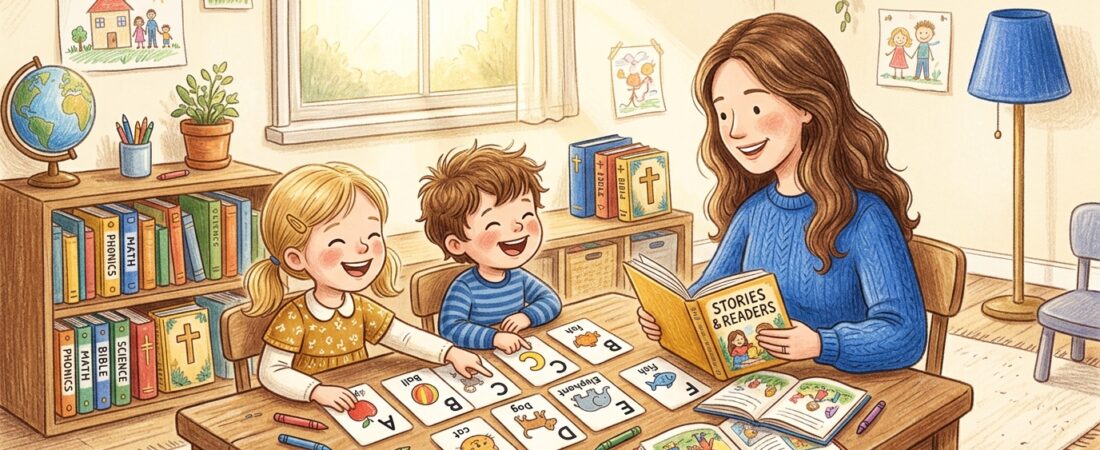
Choosing the right Christian homeschool language arts curriculum can feel overwhelming, especially when you want something that builds strong readers and writers while also nurturing your child’s faith. Whether you’re teaching a toddler her first letters or guiding a ten-year-old through grammar and composition, the right program makes all the difference. In 2026, families have more excellent options than ever before, and this guide will help you sort through them with confidence, clarity, and a faith-filled perspective.
Faith Filled Learning is reader-supported. When you buy through links on our site, we may earn an affiliate commission at no extra cost to you.
Why a Faith Based Language Arts Curriculum Matters
Language arts is more than just spelling lists and grammar drills. It is how your children learn to communicate, to understand stories, and to express their own hearts and ideas. When your curriculum is rooted in a biblical worldview, every reading passage, writing prompt, and vocabulary lesson becomes an opportunity to reinforce the values and truth you are already teaching at home.
Many secular programs are academically solid but include stories or themes that conflict with Christian values. A faith-based program eliminates that friction. Your child can read rich literature, practice writing, and develop a love for language all within a framework that points back to God. That kind of consistency matters deeply for families who are homeschooling specifically to provide a whole-life education centered on their faith.
If you are just getting started and wondering how to build a strong foundation for your youngest learners, check out this helpful guide on how to teach the alphabet to toddlers before diving into a full curriculum.
Top Christian Homeschool Language Arts Curriculum Options for 2026
Here is a look at some of the most popular and trusted programs that Christian homeschool families are using this year.
The Good and the Beautiful is one of the most beloved options available. It combines language arts, reading, and literature into beautifully designed courses with a strong moral foundation. The program covers phonics, handwriting, grammar, and writing in an integrated way that feels natural rather than choppy. Families especially love the rich literature selections and the gentle, encouraging tone throughout. You can read a full breakdown at The Good and the Beautiful review.
Sonlight Language Arts is another excellent choice, particularly if you love a literature-rich approach. Sonlight uses carefully curated read-alouds and living books to teach comprehension, narration, and writing in a way that feels more like a family reading adventure than a school lesson. Their language arts programs pair beautifully with their history and Bible programs for a cohesive, integrated homeschool day.
Abeka Language Arts offers a more traditional, structured approach that many families appreciate for its thoroughness and clear scope and sequence. Phonics instruction is systematic and rigorous, and the program maintains a distinctly Christian tone throughout. It works especially well for families who prefer a teacher-directed model with clear lesson plans.
Easy Peasy All in One Homeschool is a completely free, online Christian curriculum that includes language arts for every grade level. It is a wonderful starting point for families on a tight budget. You can learn more about this generous resource at Easy Peasy All in One Homeschool.
For families who love the Charlotte Mason method, narration, copywork, and dictation naturally form the backbone of language arts instruction. A helpful external resource for implementing this approach is Simply Charlotte Mason, which offers guides, schedules, and book lists specifically designed for Charlotte Mason families.
What to Look for in a Language Arts Program for Ages 2 to 12
Not every curriculum is right for every child or every season of your homeschool journey. Here are the key things to consider as you evaluate your options.
Scope and sequence clarity matters enormously. A good program should clearly map out what skills are covered each year so you can see where your child is headed and feel confident they are not missing foundational concepts. Look for programs that address phonics, phonemic awareness, spelling, grammar, handwriting, reading comprehension, and writing in a coordinated way.
Flexibility and pace are also important. Children ages 2 through 12 are incredibly diverse learners. A curriculum that allows you to slow down for a struggling reader or accelerate for an advanced speller will serve your family far better in the long run than a rigid one-size-fits-all program.
Teacher friendliness should not be overlooked. You are the teacher, and you deserve a curriculum that supports you without requiring hours of prep each night. Look for programs with clear teacher guides, lesson plans that are already written out, and materials that do not require you to gather a hundred different supplies from scratch.
If phonics instruction is a priority for your early readers, this resource on how to teach phonics at home is packed with practical strategies you can use alongside any curriculum you choose.
For children who are working through writing skills specifically, a dedicated homeschool writing curriculum can be a wonderful supplement to your core language arts program.
Affordable and Free Christian Language Arts Resources
Budget is a real consideration for most homeschool families, and the good news is that excellent language arts resources do not have to cost a fortune. In addition to Easy Peasy mentioned above, there are printable workbooks, copywork pages, and grammar worksheets available from many faith-based websites.
One highly recommended printed resource for young learners is the Explode the Code phonics workbook series, which provides systematic phonics practice in a simple consumable format that children can work through at their own pace. Another wonderful tool for building early literacy skills is the All About Reading Level 1 program, which uses a multisensory approach that works beautifully for a wide range of learning styles including children who struggle with traditional phonics methods.
The The Good and the Beautiful website also offers many free language arts printables and sample lessons you can download before committing to a full purchase.
Tips for Teaching Language Arts Across Multiple Ages
If you are homeschooling more than one child, teaching language arts can feel like spinning several plates at once. The good news is that some elements of language arts lend themselves naturally to family-style learning. Read-alouds are a beautiful way to build comprehension, vocabulary, and a love of story for children of all ages gathered together. You can read a chapter of a well-chosen book aloud each morning and then have each child respond in an age-appropriate way, whether that is drawing a picture, narrating back what happened, or writing a paragraph summary.
Grammar and spelling, however, are typically best taught at each child’s individual level. This is where having clear, structured workbooks for each grade pays off. You can rotate between children during your school day, giving each one a focused block of individualized instruction while others work independently on their own level exercises.
Keeping your homeschool days well organized makes a significant difference in how smoothly language arts instruction flows across multiple grade levels. A good homeschool schedule helps you carve out dedicated time for each child without sacrificing the family togetherness that makes homeschooling so special.
Frequently Asked Questions
What is the best Christian homeschool language arts curriculum for young children ages 2 to 5?
For very young children, focus on programs that emphasize phonemic awareness, letter recognition, and read-alouds rather than formal workbooks. The Good and the Beautiful has a preschool level, and Easy Peasy All in One offers free materials for early learners. Simple copywork, phonics games, and daily reading aloud together are the most developmentally appropriate language arts activities for this age group.
Do I need a separate reading curriculum and a separate grammar curriculum or can I use one program for everything?
Many all-in-one language arts programs like The Good and the Beautiful or Abeka combine reading, grammar, spelling, and writing into one cohesive program. This works well for most families. However, if your child has specific struggles in one area, such as dyslexia or advanced reading skills, you may benefit from adding a targeted supplemental program alongside your main curriculum.
How much time should language arts take each day for elementary aged kids?
For children in kindergarten through second grade, 30 to 45 minutes of focused language arts instruction each day is typically sufficient. For children in grades three through six, plan for 60 to 90 minutes to cover reading, grammar, spelling, and writing adequately. Remember that read-alouds and independent reading time also count as valuable language arts practice and can be woven throughout the rest of your school day.
Can I use a Christian language arts curriculum if my child has a learning difference like dyslexia?
Yes, but you may need to choose a program specifically designed with struggling readers in mind or supplement your main curriculum with a structured literacy approach. Programs like All About Reading are designed with dyslexic learners in mind and align well with Christian values. Always work at your child’s pace and remember that homeschooling gives you the freedom to adjust instruction in ways a traditional classroom simply cannot.
Choosing the Right Fit for Your Family
The best christian homeschool language arts curriculum for your family is ultimately the one that fits your teaching style, your child’s learning needs, and your household rhythm. Do not be afraid to try a program, evaluate it honestly after a few weeks, and make a change if something is not working. Homeschooling gives you that beautiful flexibility.
Start with a curriculum that excites you and feels manageable. Add in daily read-alouds, consistent phonics practice for younger learners, and regular writing opportunities, and you will be building a strong foundation for your children to become confident, articulate, and faith-filled communicators for the rest of their lives.
Ready to take the next step? Browse the resources linked throughout this article to find the perfect fit, and remember that you do not have to figure it all out at once. One good book, one consistent lesson, and one faithful day at a time is enough.
Printables & faith-filled tees from our shop
Bible coloring and activity books, alphabet printables and homeschool planners — instant download, print at home. Plus Comfort Colors tees for homeschool moms who get it.
Every purchase supports this blog and keeps our free resources free.