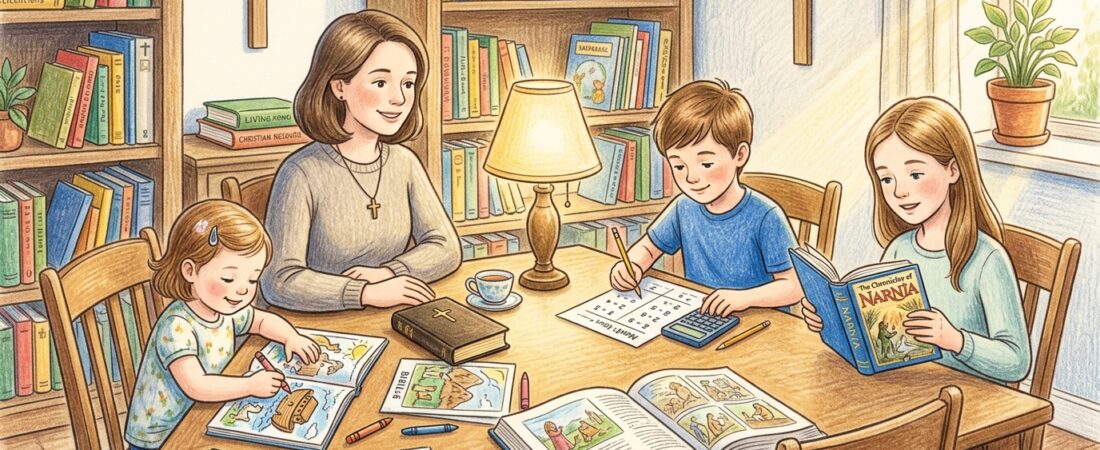
Why Teaching Multiple Ages at Once Homeschool Style Is Possible and Beautiful
If you have ever stood in your kitchen wondering how on earth you are going to teach your two-year-old her letters while your seven-year-old works through multiplication and your eleven-year-old needs help with essay writing, you are not alone. Teaching multiple ages at once homeschool style is one of the most common challenges Christian homeschool moms face in 2026, and the good news is that it is not only possible but can actually become one of the greatest gifts of home education. When children learn together, they grow together in faith, patience, and love. This guide will walk you through practical, grace-filled strategies to help your whole family thrive.
Faith Filled Learning is reader-supported. When you buy through links on our site, we may earn an affiliate commission at no extra cost to you.
Start With a Rhythm That Anchors Your Day
Before you can successfully teach multiple ages at once, you need a daily rhythm that gives everyone a sense of security and flow. This is different from a rigid schedule. A rhythm is a gentle pattern your children can anticipate, which reduces the chaos that so often derails multi-age homeschool days. Begin each morning with a family Bible time, prayer, or a short devotional. This anchor sets the tone and reminds everyone, including you, why you are doing this. After your family time, move into your independent work block where older children work on subjects like math or writing on their own while you give focused attention to your youngest learners. Consider posting a visual schedule on the wall so even your preschooler can see what comes next. If you need help mapping this out, check out this helpful resource on how to create a homeschool schedule that fits your unique family.
During your rhythm planning, think in blocks rather than individual subjects. A morning block for reading and language arts, a midday block for hands-on activities and science, and an afternoon block for independent work and enrichment can cover a surprising amount of ground. You do not need to teach every child every subject separately every single day.
Use Teaching Multiple Ages at Once Homeschool Methods Like Loop Scheduling and Unit Studies
Two of the most effective tools for multi-age homeschooling are loop scheduling and unit studies. A loop schedule is a list of subjects you cycle through rather than assigning them to specific days. If you never get to art on Monday, it simply becomes the next item on Tuesday. This removes guilt and keeps things moving without requiring perfection. A unit study, on the other hand, allows all your children to learn the same topic simultaneously at their own depth level. If you are studying ancient Egypt, your five-year-old can color pyramids and listen to read-alouds, your eight-year-old can narrate what she learned, and your eleven-year-old can write a short research report. Everyone is learning together, and you are only preparing one topic. Homeschool unit studies are especially powerful because they naturally accommodate different ages and learning styles, and they make family learning feel like an adventure rather than a chore.
For history specifically, teaching all your children from the same spine is a game changer. You might explore how to teach history at home in a way that layers depth for each age without requiring you to plan four separate lessons. Many families choose a four-year rotating history cycle precisely for this reason, so every child hears every era of history at least twice during their schooling years.
Choosing Curriculum That Supports Multiple Ages
Not all curriculum is created equal when it comes to multi-age households. You want resources that are either explicitly designed for multiple levels or that are easy to adapt. All-in-one programs can be lifesavers because the planning is done for you. Some families love the Charlotte Mason approach, which naturally lends itself to multi-age learning through living books, narration, and nature study. Others prefer classical methods that follow a predictable three-stage cycle across grades. Still others find that a structured all-in-one curriculum keeps the overwhelm at bay.
For your youngest learners ages two through five, keeping things simple and sensory-rich is key. A toddler does not need a formal curriculum. She needs songs, picture books, finger painting, and time spent snuggled beside you while you read aloud to her older siblings. One excellent resource for your littlest ones is Timberdoodle, which offers carefully curated kits for each age level designed to develop skills through play. For your elementary-aged children, look for programs with teacher guides that include simplified and enriched options in the same lesson. The Five in a Row curriculum is a beloved literature-based option that works beautifully for ages four through twelve by building multiple subjects around a single picture book each week. You can read aloud the story to everyone, then assign age-appropriate follow-up activities to each child.
When your older children ages ten through twelve are ready for more independent study, invest in programs that build self-directed learning habits. This frees you to pour attention into your younger ones. Consider tools like Khan Academy for supplemental math and science practice that children can work through on their own at no cost.
Practical Tips for Keeping the Peace While Teaching Multiple Ages
Let us be honest. Some days the toddler will dump the crayons while you are mid-lesson with your third grader, and your fifth grader will insist she does not understand the assignment the moment you finally sit down. This is normal, and it does not mean you are failing. Here are some practical strategies that make multi-age homeschooling more peaceful in the daily grind.
First, invest in a good quiet basket for your youngest. Fill a special basket or bin with activities your toddler or preschooler only gets during school time. Sticker books, a simple Melissa and Doug wooden puzzle set, play dough, or board books reserved for school hours can buy you twenty to thirty focused minutes with your older learners. Second, train your older children to work independently before adding a new sibling to your household school. Start with just fifteen minutes of independent work, then gradually increase. Children as young as seven can learn to read instructions, complete a math page, and move on without constant hand-holding if you build the habit slowly. Third, do not try to do everything every day. History three days a week, science twice a week, and daily reading and math is a full and rich education. Give yourself permission to focus.
Finally, remember that sibling teaching is one of the most powerful tools in your multi-age toolbox. An older child who explains a concept to a younger sibling understands it more deeply herself. Build in moments where your nine-year-old reads aloud to your four-year-old or helps her practice letter sounds. These moments build relationship alongside academics, and that is exactly what Christian homeschooling is all about.
Encouragement for the Overwhelmed Multi-Age Homeschool Mom
If you are feeling stretched thin in 2026, you are in good company. Teaching multiple ages at once homeschool style is genuinely hard work, but it is also extraordinarily meaningful. You are weaving your children’s education together in a way that school buildings simply cannot replicate. They are watching you rely on God each morning. They are learning that patience is a virtue because they see you practice it every day. They are growing up knowing their siblings as true friends and fellow learners.
On the hard days, remember that consistency matters far more than perfection. A good enough lesson delivered with love and a calm spirit will serve your children better than a perfect lesson plan executed in frustration. Lean into your faith community, connect with other homeschool moms, and do not hesitate to ask for help. Organizations like HSLDA offer resources, legal support, and encouragement specifically for homeschooling families, and connecting with their community can remind you that you are never doing this alone.
You were chosen for these specific children at this specific time. Teaching them together, in the same home, under the same roof, with the same faith shaping every lesson, is a calling worth every chaotic, beautiful day.
Ready to get more organized and intentional in your multi-age homeschool? Start by mapping out your family’s rhythm this week, and explore the resources linked throughout this article to find the tools that will serve your unique crew best. You have got this, mama.
Printables & faith-filled tees from our shop
Bible coloring and activity books, alphabet printables and homeschool planners — instant download, print at home. Plus Comfort Colors tees for homeschool moms who get it.
Every purchase supports this blog and keeps our free resources free.