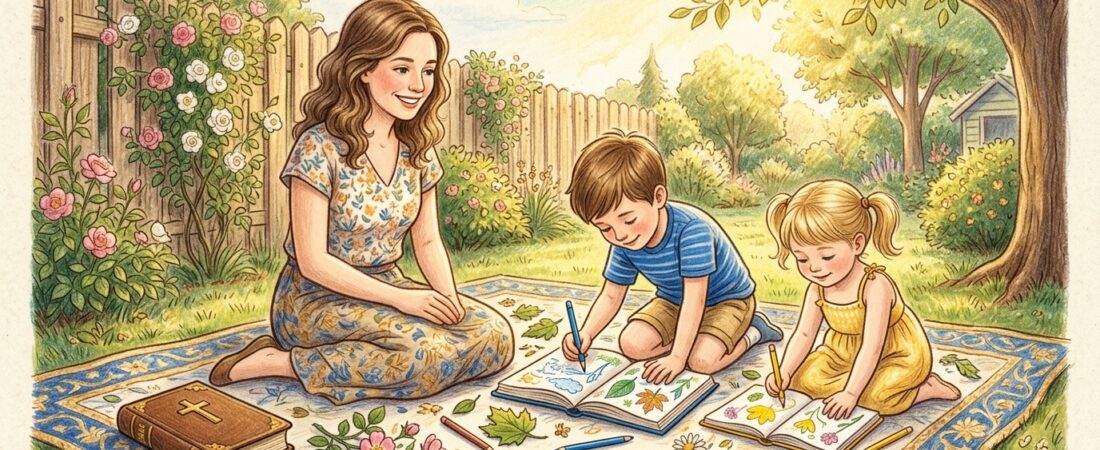
If you are looking for a simple, meaningful practice to weave into your days, nature journaling for kids in your Christian homeschool may be exactly what your family needs. This beautiful habit blends science, writing, art, and Scripture into one gentle activity that children from toddlers to preteens can enjoy together. Whether you school in the backyard, a local park, or at your kitchen table with a windowsill collection of leaves and rocks, a nature journal invites your children to slow down, observe God’s creation with wonder, and record what they discover. In 2026, more Christian homeschool families than ever are embracing this practice, and for good reason.
Faith Filled Learning is reader-supported. When you buy through links on our site, we may earn an affiliate commission at no extra cost to you.
Why Nature Journaling Fits Perfectly Into a Christian Homeschool
Creation care and wonder are deeply rooted in Scripture. Psalm 19:1 reminds us that the heavens declare the glory of God, and Romans 1:20 tells us that God’s invisible qualities are clearly seen through what He has made. When children slow down to sketch a caterpillar or press a fall maple leaf into their journal, they are participating in an act of worship without even realizing it. Nature journaling gives kids a tangible way to connect their faith to the world around them, building what many Charlotte Mason educators call a living relationship with creation.
This is why nature journaling pairs so naturally with the Charlotte Mason homeschool philosophy, which emphasizes living books, outdoor time, and narration over rote memorization. If you are exploring that approach for your family, you might find our guide to Charlotte Mason nature study especially encouraging. The methods overlap beautifully and can be applied to children of nearly every age.
Beyond the spiritual dimension, nature journaling builds a surprising number of academic skills. Children practice observation, descriptive writing, illustration, classification, and even basic scientific reasoning every time they open their journal. For younger children ages two through five, it develops fine motor skills and vocabulary. For older children ages six through twelve, it can grow into a rich science and writing portfolio.
How to Get Started With Nature Journaling for Kids in Your Christian Homeschool
The most important thing to know is that you do not need expensive supplies or a perfect curriculum to begin. A blank composition notebook and a box of colored pencils will serve you well. That said, having a dedicated journal does make the practice feel special, and children are more likely to take care of something that feels like their own. A great starting point is a blank nature journal for kids with unlined pages that give little artists plenty of room to sketch and write.
Here is a simple routine you can start this week:
Step 1: Go outside or bring nature inside. You do not need a forest. A backyard, a potted plant, a pinecone, or a bird feeder by the window all work. The goal is to give your child something real to observe.
Step 2: Look before you draw. Encourage your child to spend one full minute just looking at their subject. Ask questions like, what colors do you see? Does it have a smell? How does it feel? This slows them down and sharpens their attention.
Step 3: Sketch and label. Younger children can draw freely and you can write labels for them. Older children can label parts of a leaf or insect and add a date, location, and weather note. Even imperfect drawings are full of learning.
Step 4: Add a verse or prayer. This is the step that sets Christian homeschool nature journals apart. Encourage your child to copy a short Scripture related to what they observed or to write a one-sentence prayer of gratitude. This simple habit roots the practice in faith.
For families with children of mixed ages, nature journaling is one of those rare activities that works beautifully for everyone at once. A two-year-old can paste in a leaf while a ten-year-old sketches and researches the same species side by side.
Nature Journaling Ideas and Prompts for Ages 2 Through 12
One of the most common questions homeschool moms ask is how to keep nature journaling fresh across the seasons and across such a wide age range. The answer is to follow your children’s curiosity and rotate through simple prompts.
For ages 2 to 5: Leaf rubbings, finger-painted sunsets, pasting feathers or pressed flowers, and dictating one sentence about what they saw. Keep sessions short, ten to fifteen minutes, and celebrate every effort enthusiastically.
For ages 6 to 8: Sketching a backyard bird and identifying its name, drawing the same tree across four seasons, or illustrating the life cycle of a butterfly. Pair their drawings with a simple written narration of two to three sentences.
For ages 9 to 12: Detailed observational drawings with measurements and labels, moon phase tracking logs, weather pattern charts, or written reflections connecting what they observed to what they are studying in science. Older children can also begin researching the Latin names of plants and insects they find.
For inspired seasonal themes throughout the year, resources like Simply Charlotte Mason offer structured nature study guides designed to grow with your child from preschool through middle school. These can give you a gentle framework without making the activity feel like schoolwork.
You can also integrate nature journaling with other subjects. A study of birds can tie into a unit on migration geography. A pressed herb collection can connect to a botany or cooking lesson. A sketch of a spider web can launch a discussion of engineering in creation. The cross-curricular possibilities are one of the biggest advantages of this practice for Christian homeschool families who value an integrated, God-centered education.
Supplies That Make Nature Journaling More Enjoyable
While you truly can begin with what you have at home, a few quality supplies make the experience more enjoyable and sustainable for kids over time. Here are some gentle recommendations:
A set of watercolor pencils for kids nature journals is a wonderful upgrade from standard colored pencils because children can sketch dry and then add water for a beautiful painted effect. This feels like magic to younger children and is simple enough for little hands to manage.
A hand lens or magnifying glass makes small subjects like ant antennae or flower stamens suddenly visible and endlessly fascinating. You can find inexpensive ones at most craft or science supply stores, and they are worth every penny for the wonder they spark.
A field guide tailored to your region helps children identify what they find. Many Christian publishers offer creation-based field guides and nature books that frame discoveries within a biblical worldview, which fits seamlessly into your homeschool day.
If you are also looking for beautiful printable resources to complement your journaling sessions, our collection of Christian homeschool printables includes nature-themed pages that younger children especially love to color and label.
Making Nature Journaling a Lasting Habit in Your Homeschool
The families who benefit most from nature journaling are those who make it a consistent rhythm rather than a special event. You do not need to journal every day. Even once or twice a week builds a rich habit over time, and after a full year your child will have a beautiful record of seasons, discoveries, and growing skill.
A few tips for building the habit: choose a consistent time, perhaps right after morning devotions or just before lunch, keep supplies in an easy-to-reach basket, and journal alongside your children whenever you can. When children see their mom drawing a dandelion and writing a verse beneath it, they understand that this activity is worth their time and attention.
Nature journaling also pairs wonderfully with unit studies. If your family is studying animals, weather, plants, or even world geography, a nature journal component adds hands-on depth that children remember long after the unit is finished. You can learn more about building meaningful thematic studies in our guide to homeschool unit studies.
Finally, do not worry about perfection. The journal is not meant to be a museum piece. It is a living document of your child’s growing relationship with God’s world, and the crooked sketches and misspelled plant names are part of what makes it precious. Some of the most treasured homeschool memories are preserved in those imperfect pages.
Conclusion
Nature journaling for kids in your Christian homeschool is one of the simplest and most rewarding practices you can build into your family’s rhythm. It cultivates awe, sharpens observation skills, builds writing and art abilities, and most importantly, it turns everyday moments in creation into opportunities to know and worship the God who made every leaf, bird, and thundercloud. Whether your child is two years old and pasting in their first dandelion or eleven years old sketching constellations in a midnight journal, this practice has room for them exactly where they are. Start small, start this week, and watch your children fall in love with the world God made for them to explore.
Ready to begin? Grab a blank journal, head outside with your kids, and let creation be your classroom today. We would love to hear how your family’s nature journaling journey unfolds!
Printables & faith-filled tees from our shop
Bible coloring and activity books, alphabet printables and homeschool planners — instant download, print at home. Plus Comfort Colors tees for homeschool moms who get it.
Every purchase supports this blog and keeps our free resources free.